Anthropic Releases Claude Fable 5.1 and Claude Mythos 5.1
Anthropic released Claude Fable 5.1 and Claude Mythos 5.1 on September 1, 2026, at unchanged $10/$50 pricing with a 75% cheaper cache read and a government-vetted Mythos access program after Fable 5's June export-control suspension.

Anthropic released Claude Fable 5.1 and Claude Mythos 5.1 on September 1, 2026, and it is not being subtle about what it thinks of them. “They’re the world’s most advanced models for coding and knowledge work,” the company wrote in its announcement, a line it also posted verbatim from the @claudeai account on X the same day.
For developers already running Claude Fable 5, the same $10/$50 per million token price now comes with a 75% cheaper cache read. Three breaking API changes also ship alongside the model. There is also a piece of recent history worth reading first: what happened the last time Anthropic shipped a model with this name.
Fable 5.1 Ships at Two Safeguard Tiers
Fable 5.1 and Mythos 5.1 are, per Anthropic’s own model documentation, the same underlying model shipped at two different safeguard levels. Fable 5.1 is generally available to any developer with a Claude API key today. The spec line: model ID claude-fable-5-1, a 1M token context window, 128K max output tokens, adaptive thinking always on, and a June 2026 knowledge cutoff.
Mythos 5.1 is restricted to vetted US organizations admitted through Anthropic’s Cyber Verification Program and Life Sciences Verification Program, both run under the umbrella of Project Glasswing. Access to Mythos is vetted rather than purchased: organizations apply through those programs, and approval rests with Anthropic in consultation with the US government.
The company’s launch announcement says its cybersecurity safeguards now flag benign requests about 60% less often than before, and a separate biology and medical safety fallback, which routes uncertain research queries to a more restrictive response, now triggers roughly 85% less often by the same account. The system card that shipped alongside the models adds a new set of anti-distillation mechanisms meant to stop competitors from cheaply copying the model’s outputs to train their own.
Fable 5’s Rocky June
Anthropic’s track record with a Fable-class model is not spotless, and a security team evaluating 5.1 should know the history before it flips the switch. Anthropic launched the original Claude Fable 5 and Claude Mythos 5 on June 9, 2026, and the celebration lasted all of three days.
The US government directed Anthropic to suspend access to both models on June 12, in an export control directive citing national-security authorities, after researchers at Amazon reported a method of bypassing Fable 5’s safeguards. The suspension reached foreign nationals both inside and outside the United States, including Anthropic’s own foreign-national employees, and it landed within days of the original launch.
The US government lifted the export controls on June 30, and Anthropic redeployed Fable 5 the next day with a new cybersecurity classifier the company says blocks the specific jailbreak in more than 99% of attempts, rerouting flagged requests to the more restrictive Claude Opus 4.8 rather than failing them outright. A short stretch of subscription confusion followed the redeployment: when the launch promotion ended on July 19, Fable landed permanently on Max plans at 50% of weekly limits, while eligible Pro subscribers received usage credits plus a one-time credit.
That record is the backdrop for the government-approval structure built into Mythos 5.1’s access programs, covered further down. It is also the reason a security team's first question should be what changed inside the classifier this time, well before it gets to the benchmark table.
The Benchmarks Anthropic Is Citing
Every number below is Anthropic’s own reporting, run on its own benchmarks, so read it as a vendor claim rather than an independent result. The one that anchors the announcement is Terminal-Bench-Science 0.1, a research-agent benchmark where Fable 5.1 scored 52.6% against Fable 5’s 24.7%, more than double the prior model in a single release. Anthropic is using that jump to argue the models offer, in its words, “an early glimpse of how AI models will contribute to scientific progress.”
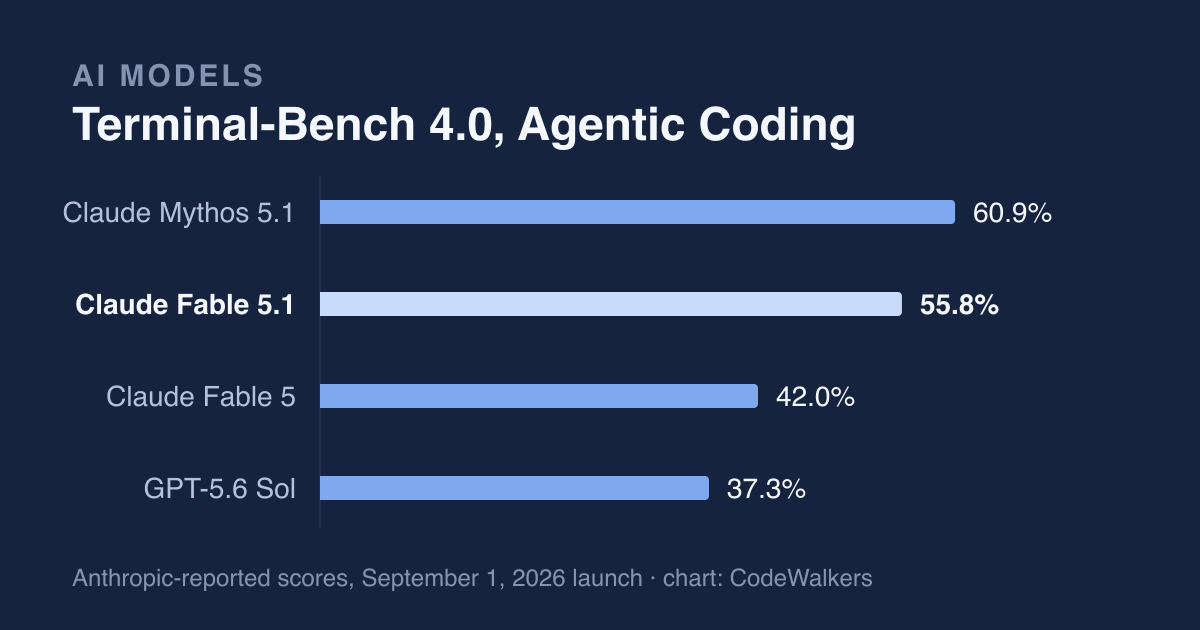
On coding specifically, Fable 5.1 hit 55.8% on Terminal-Bench 4.0, up from Fable 5’s 42.0%, and Mythos 5.1 reached 60.9%. Anthropic’s own benchmark table puts a rival model, GPT-5.6 Sol, at 37.3% on the same benchmark, its comparison rather than an independent test. On knowledge work, GDPval-AA v2 put Fable 5.1 at 1,853 against Fable 5’s 1,723. Computer-use scores landed at 41.7% on the strict version of OSWorld 2.0, and Humanity’s Last Exam with tools came in at 65.0%. CursorBench 3.2.0 scored 73.4%, and AutomationBench came in at 31.4%.
Anthropic also says that at lower effort settings, Fable 5.1 matches or beats Fable 5’s results at a meaningfully lower cost. That is worth testing directly rather than defaulting every call to the high effort setting the model ships with, since effort is the lever that trades benchmark score for token spend.
The research showcases are the part worth reading past the scoreboard. Anthropic says researchers using the models designed protein binders with roughly ten times the binding affinity of competing methods and a 50% hit rate, against a typical 10 to 15%.
A separate team improved the resolution of a Venus elevation map from 10 to 20 kilometers down to 2 to 3 kilometers, and another used the models to optimize GPU kernels by up to 2.5 times. None of these are independently reproduced yet. They are Anthropic’s own case studies.
Same Price, a Much Cheaper Cache
The pricing story is simpler than the benchmark table. Input still costs $10 per million tokens and output still costs $50 per million tokens, unchanged from Fable 5. The change is cache reads, which drop from the standard 10% of base input price to $0.25 per million tokens, a 75% cut.
Anthropic says that works out to roughly 25% savings on typical workloads and up to 45% on highly agentic tasks, where a coding agent rereads the same growing context on every turn. Batch API requests stay at the usual 50% discount, putting batch pricing at $5 input and $25 output.
The cut also changes the competitive math against OpenAI. GPT-5.6 Sol currently runs $4 input and $20 output per million tokens under promotional pricing OpenAI has committed to through November 21, 2026, with cached input at $0.40 per million. Fable 5.1’s base rates stay at 2.5 times Sol’s, but its cache reads now undercut Sol’s at $0.25 against $0.40, and Anthropic prices the full 1M token context window at standard rates while Sol bills double input and 1.5 times output on any request past 272K input tokens.
Developers ran that same math within a few hours of the launch. AI founder Matt Shumer posted on X:
Fable 5.1 is a massive upgrade, but the bigger story is how much cheaper it is. This puts it much closer to the pricing of GPT-5.6-Sol, while being a much more capable model.
Anthropic’s own guidance is worth repeating here, because it is not the pitch you would expect from a model launch: “For most workloads, start with Claude Opus 5,” the docs say, reserving Fable 5.1 for “demanding reasoning and long-horizon agentic work” where Opus 5 at higher effort still falls short. Opus 5 runs $5/$25 per million tokens, Sonnet 5 runs $2/$10. Fable 5.1 is the expensive, slower option in the lineup, and Anthropic is telling developers to reach for it deliberately rather than by default.
Three Breaking API Changes
Anyone with existing Fable 5 integrations should read the what’s new page before flipping the model ID. Three changes break existing code outright, starting with forced tool use: a tool_choice value of any or tool now returns a 400 error instead of forcing a call.
The second change: earlier Claude models can no longer read Fable 5.1’s thinking blocks, a one-directional restriction that matters for any pipeline that hands reasoning off between model versions. The third: editing an earlier turn in a conversation now invalidates the thinking blocks attached to it, and for accounts created on or after August 31, 2026, that check enforces conversation history as append-only.
The append-only rule is the one worth planning around, though it is narrower than it sounds. Server-side context compaction and Anthropic’s context-editing tools remain the sanctioned way to manage a long conversation under the new rule; what breaks is a framework that silently rewrites or deletes earlier turns on its own. If your agent code does that to manage context length, that pattern stops working cleanly on new accounts the moment Fable 5.1 is in the loop, and it is a real migration item rather than a footnote.
Five other changes are additive rather than breaking: per-message effort changes mid-conversation without invalidating the prompt cache, turn-scoped system messages that clear themselves after the next user message, progress updates streamed between tool calls during long agentic runs, the cheaper cache pricing above, and content provenance, covered next.
Text Output Now Carries a Watermark
The release also switches on content provenance by default. Text that Fable 5.1 and Mythos 5.1 generate now carries a statistical watermark on every platform where the two models run, and Anthropic says it adds no tokens or hidden characters and carries no information about you or your organization. Images and video get a separate mechanism, signed C2PA Content Credentials attached through the Files API.
Code gets a meaningful carve-out that developers will care about. Anthropic’s watermark explainer says the signal embeds only where the model has an arbitrary choice between words, so most exact-output code carries little of it, though comments inside code can. How the watermark is detected, who can verify it, and how it holds up in practice is a bigger story than a launch note can carry.
Mythos Is Not Public, and Washington Is in the Loop
Say this plainly, because a vendor overview page is easy to skim past it: Claude Mythos 5.1 is not available to the public, and no signup form gets you there. Fable and Mythos are the same underlying weights running at two different safeguard levels, and which one an organization gets depends on whether Anthropic and the US government have vetted it, not on what it is willing to pay.
Mythos 5.1 ships only through Project Glasswing, Anthropic’s defensive-cybersecurity initiative run in collaboration with the US government. Access runs through an application to the Cyber Verification Program for security teams or the Life Sciences Verification Program for biology and medical researchers, with Anthropic’s approval granted in consultation with the US government. Applying is not enrolling: vetting decides who gets in, and existing cloud customers are pointed to their Anthropic, AWS, or Google Cloud account team.
Glasswing recently expanded by roughly 150 new organizations across more than 15 countries, on top of an initial cohort of around 50 partners, according to Anthropic and CyberScoop’s reporting on the expansion. Participants have included Amazon Web Services, Cisco, CrowdStrike, Google, JPMorganChase, the Linux Foundation, Microsoft, NVIDIA, and Palo Alto Networks. Anthropic says the Mythos preview has surfaced more than 10,000 high- or critical-severity vulnerabilities for participants since April 2026.
Anthropic’s own system card is candid about a cost of running fewer safeguards. TechCrunch’s read of the document says Mythos 5.1 shows a slight alignment regression against Opus 5, quoting the card’s finding that the model “cooperates with human misuse and accepts unverifiable claims of authorization somewhat more readily.” That is the trade the vetting process exists to manage, stated openly in the document rather than left for a reporter to dig up.
A separate protection, Enterprise Frontier Safeguards, targets a different worry: enterprise customers who want Mythos-tier capability without exposing their data to it. Anthropic describes EFS as delivering complete privacy, the same standard as zero data retention, while remaining state-of-the-art at preventing adversarial use, and says it rolls out in phases starting this fall. On training, the company’s position stays unambiguous either way. “Anthropic has never trained on enterprise data without explicit permission, and never will,” it said in the launch materials, as reported by TechCrunch.
What This Costs You on Claude.ai and Claude Code
Developers calling the API pay per token, but most readers reach Fable 5.1 through a Claude.ai or Claude Code subscription, and the mechanics there differ by plan. For an individual on Max, or a Team or Enterprise seat on a premium plan, Fable models are included: you can use up to 50% of your weekly usage limits on Fable models at no extra cost, according to Anthropic’s support documentation.
That allowance is not bonus usage on top of your plan. Fable draws from the same weekly pool as every other model and burns through it faster, so the ceiling is still your normal weekly limit, not a separate allowance. Once you reach the 50% Fable share, you continue on usage credits or switch to a cheaper model for the rest of the week.
The cheaper cache also reaches subscribers on Claude.ai and Claude Code. Cache reads have always counted toward subscription usage at a reduced rate, and Anthropic developer advocate CJ Avilla, answering a question about Claude Code costs, said on X he had “confirmed with the team” that Fable 5.1’s cache reads are “reduced against subscription usage limits today.” Long cache-heavy sessions should drain the weekly pool more slowly than the raw token math suggests.
For Pro, standard Team, and standard Enterprise seats, there is no included allowance at all. Fable models run on pay-as-you-go usage credits only, the same terms as any other premium model on those tiers.
Anthropic’s support page is explicit that the mechanics carry over unchanged from the prior model: “Fable 5 and Fable 5.1 work the same way on your plan.” The two models coexist rather than one replacing the other, and unlike July’s rollout, there is no promotional credit attached to 5.1. The one-time $100 credit Pro subscribers received when Fable 5’s subscription confusion ended was specific to that launch and has not repeated.
The in-app announcement on claude.ai frames the pitch for non-developer users plainly:
Claude Fable 5.1 is now available. Included for up to 50% of your Max plan usage.
Its bullet points promise the model “sticks to what you asked for and asks when it’s unclear” and “shows its sources and separates what’s known from what’s estimated.”
Sources
-
[1]
Claude Fable and Mythos 5.1(anthropic.com)
-
[2]
Claude Fable 5.1 overview(platform.claude.com)
-
[3]
What's new in Claude Fable 5.1(platform.claude.com)
-
[4]
Claude Fable 5.1 and Mythos 5.1 system card(anthropic.com)
- [5]
- [6]
- [7]
-
[8]
Redeploying Claude Fable 5(anthropic.com)
-
[9]
Anthropic restores Claude Fable 5 after new cybersecurity classifier(thehackernews.com)
-
[10]
Claude Fable 5 on your plan(support.claude.com)
-
[11]
Project Glasswing(anthropic.com)
-
[12]
Expanding Project Glasswing(anthropic.com)
- [13]
-
[14]
Anthropic's new Fable release is cheaper, less restrictive(techcrunch.com)
-
[15]
GPT-5.6 Sol model page and pricing(developers.openai.com)
- [16]
Read Next
Anthropic launched Claude Fable 5 on June 9, 2026, the first generally available Mythos-class model, priced at $10/$50 per million tokens with safety classifiers that reroute sensitive requests to Claude Opus 4.8.
Anthropic released Claude Opus 5 on July 24, 2026, holding the $5/$25-per-million-token price it has charged since Opus 4.6, with beta features for mid-conversation tool changes that preserve the prompt cache and automatic fallbacks for safety-flagged requests.
Written by Matthew Lake
Recent News
- Everything OpenAI Announced at DevDay 2026 Oct 1
- OpenAI Launches dots, Always-On ChatGPT Agents with Their Own Computers Sep 29
- Claude Opus 5.5 Claims Fable 5.1 Performance at 60% Lower Prices Sep 23
- OpenAI Releases GPT-6 Sol and Luna at Half GPT-5.6 Promo Prices Sep 23
- SpaceXAI Grok 4.7: Same $2/$6, Strong Cost-for-Performance on CursorBench Sep 22