OpenAI Launches dots, Always-On ChatGPT Agents with Their Own Computers
OpenAI launched dots at DevDay on 29 September 2026: GPT-6 Astra agents with their own cloud computer that work around the clock for Pro and Business Premium users, reachable in ChatGPT, Slack and Teams.
Editor's note (): OpenAI changed its dots help article on 30 September: for the first month, the plan's dots allowance now has extended limits, rather than dots usage not counting toward plan allowances.


OpenAI launched dots at its DevDay keynote on 29 September 2026: always-on agents in ChatGPT that run on GPT-6 Astra, each with its own cloud computer and browser. According to OpenAI's launch post, dots are rolling out gradually to Pro and Business Premium users, though OpenAI's help center says Pro users in the EEA, Switzerland and the UK are left out for now. The first dot comes with the plan at no extra cost.
The launch puts OpenAI into a category that filled up fast this quarter. SpaceXAI (formerly xAI) put Grok Bot into beta seven weeks earlier, Meta launched its Muse agent three weeks earlier, and SpaceXAI opened Team Bots to its business plans on 28 September, the day before the keynote.
Dots led a keynote that OpenAI says carried more than 20 major announcements, among them a cheaper near-Astra model called GPT-6.1 Sol, a $500-a-month Pro 500 plan with a faster Ultrafast tier, Codex in the cloud, and computer use in the Agents API. Our DevDay round-up covers those launches one by one.
What the Always-On Agent Does
A dot works on a cloud computer of its own, using its own browser and the apps you connect, and OpenAI says it can keep working towards your goals around the clock. Plugins give it access to more than 4,000 apps, and you can open the dot's computer at any point to check what it did. With your permission it can also connect to your laptop and work there.
You reach it wherever you already talk to colleagues. It answers messages in ChatGPT on desktop, web and mobile, and in Slack and Microsoft Teams, and you can call it by voice. Texting is a limited beta for some Pro users in the US only, and the dot can't call you at launch. OpenAI says the dot carries context across every channel, so a project started in ChatGPT can continue in a Slack thread.
A dot also takes on several projects at once without separate threads, and it learns from feedback over time. OpenAI's developer example has the dot watch customer feedback, scope small fixes, build and test them, and bring back pull requests with videos of the changes for review. Outside OpenAI, one early tester's dot noticed a forgotten invoice, prepared it, and sent it once he approved.
For now each person starts with one primary dot and gives it a name. OpenAI says it expects teams of dots to work together over time, and that you will later be able to add more of them.
Who Gets It and What It Costs
Dots are rolling out gradually from 29 September, and OpenAI's help center says access may take several days to reach an account.
- Pro (every tier, from $100 a month): everywhere ChatGPT is sold except the European Economic Area, Switzerland and the UK.
- Business Premium: available in every region where ChatGPT supports the plan.
- Enterprise, Edu and Healthcare: a beta that stays off until a workspace admin switches it on.
- Not included yet: Free, Go, Plus and standard Business seats. OpenAI says it plans to expand dots to more users soon.
- Setup: create the first dot in the ChatGPT desktop app (Mac or Windows) or ChatGPT on desktop web. You can't create one on mobile, and mobile web isn't supported, but after setup you can message it from the mobile app.
To check whether your account has dots yet, open chatgpt.com/dots. If dots have reached your account, that address opens your dot. Until the rollout reaches your account, or if you are outside the eligible markets, ChatGPT shows the notice below, even on a Pro plan. OpenAI's launch post remains the official source for who gets dots and when.
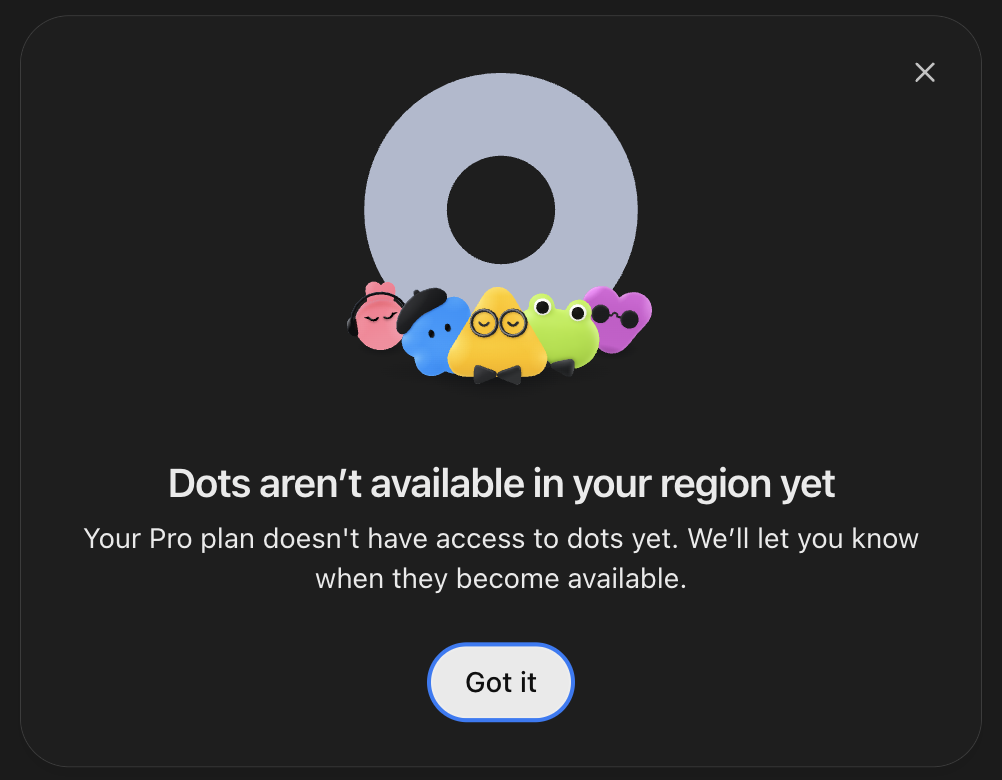
OpenAI has set out these billing and usage rules so far.
- Your first dot is included in Pro and Business Premium at no extra charge.
- For the first month, the plan's dots allowance has extended limits, according to OpenAI's help center. OpenAI says it will share usage terms for each plan after that.
- OpenAI's launch post adds that chatting with a dot doesn't count toward ChatGPT limits, while tasks it starts in Codex or ChatGPT Work count as usual.
Pro now comes in three monthly tiers, per OpenAI's Pro tiers help article (read 30 September): Pro 100 at $100, Pro 200 at $200, and Pro 500 at $500, all in US dollars. The ChatGPT pricing page lists "Dot, your always-on agent" on the Pro card, which covers all three tiers, so Pro 100 is the lowest-priced individual plan with a dot. Business Premium is the Business plan's premium seat, and the page we checked showed it in local currency only, so we have not printed a US price for it.
OpenAI also says you will be able to buy each dot extra speed or a bigger monthly workload. It has not published prices for extra dots or for either upgrade.
Approvals and Safeguards
OpenAI's launch post lists these controls for an agent that keeps working while you are away:
- Each dot runs on its own cloud computer, and your own machine stays separate unless you connect it.
- Saved passwords sign it in to supported sites without exposing them to the model.
- Background "proactive research" uses read-only tools, which cannot send messages or change app content.
- Custom Rules let you allow an action, require approval for it, or block it, and Activity View shows background work as it happens.
- An auto-review step checks consequential actions against your rules, and some tasks, such as changing a password, always stay with you.
- OpenAI's monitoring can pause or stop a dot when it detects a safety concern.
On training, OpenAI says it doesn't use Business, Enterprise or Edu content to improve its models by default, and personal plans can opt out. It also says it doesn't train directly on proactive research or on a dot's notes to itself. The launch post points to a system card and a separate dots safety post, and it tells users to review consequential work because dots can still make mistakes.
Specialist Agents for Companies
OpenAI is also previewing specialist dots, which a company sets up to own a defined job inside the organization. Each gets its own identity for access management, its own credentials, IT-provisioned hardware, and connections to the company's systems of record.
They start as enterprise pilots, with OpenAI's engineers working alongside each customer to set the dot's responsibilities, tools and approval steps. OpenAI says its internal testing covered procurement, invoice processing, email marketing, customer support and commercial contracting. It is also working with Microsoft so companies can govern specialist dots through Microsoft Agent 365.
How It Compares with Muse, Grok Bot, and OpenClaw
Three always-on agents already had a head start on dots. The table uses each vendor's own pages, read between 24 and 30 September 2026, and CodeWalkers has not tested dots, so it compares what each vendor states and ranks nothing.
| Agent | Runs On | Reach It In | Access |
|---|---|---|---|
| dots (OpenAI) | Its own cloud computer, on GPT-6 Astra | ChatGPT, Slack, Teams, voice calls | Pro from $100/month; Business Premium |
| Muse (Meta) | A dedicated virtual machine, per Meta | Muse app, muse.ai, WhatsApp; US launch | Free weekly allowance; Power $20/month |
| Grok Bot (SpaceXAI) | One cloud computer shared by your Bots | Desktop and mobile apps; Slack for Team Bots | SuperGrok $30/month or Cursor Pro $20/month |
| OpenClaw | Your own hardware, self-hosted | WhatsApp, Telegram, Slack and 20+ more | Free (MIT); you pay your model provider |
Sources: OpenAI's dots post, Meta's Muse announcement and Muse subscriptions help page, SpaceXAI's Grok Bot documentation and Team Bots post, and the OpenClaw repository, all listed under this article's sources. Grok Bot and Cursor prices are from our Grok Bot guide, checked on 24 September.
The clearest difference between the four is how each one isolates its work. OpenAI says each dot works on its own cloud computer, while SpaceXAI's documentation says every Bot on one account uses the same computer, and that the Bots' screens are separate work surfaces rather than security boundaries. Muse keeps its work inside a dedicated virtual machine, and OpenClaw runs wherever you install it, so its isolation depends on your own setup.
Billing also works differently across the four services. Grok Bot draws on its own weekly usage pool, separate from Grok and Cursor limits, and Muse counts weekly Muse tokens, with the Max plan at $100 a month above Power. Dots sit inside the ChatGPT plan rather than a separate subscription. OpenAI's launch post says chatting with a dot doesn't count toward ChatGPT limits, while work routed through Codex or ChatGPT Work counts as usual, and the help center says the plan's dots allowance has extended limits for the first month.
Shared agents for teams are the third point of difference. SpaceXAI put Team Bots into public beta on its Teams and Enterprise plans on 28 September, with one shared Bot that keeps private conversations and memories per person. OpenAI's answer for organizations is specialist dots, which are still pilots, plus a new ChatGPT Space where teammates and their dots share knowledge.
OpenClaw also turns up on OpenAI's side of DevDay. It is one of the 16 partner tools for Sign in with ChatGPT, so Plus and Pro users can spend their ChatGPT plan allowance on eligible OpenAI usage inside it.
What to Try First
If you are on Pro or a Business Premium seat, setup starts in the ChatGPT desktop app or a desktop browser, where you name the dot and connect apps. You pick which apps it can reach through ChatGPT's existing app controls, so the smallest first step is to connect one app and leave the rest off.
OpenAI's launch post describes Custom Rules and an Activity View. Before handing a dot a real job, use Custom Rules to set the actions that should need your approval, then watch its first background work in Activity View. OpenAI's own developer example, a dot that turns customer feedback into pull requests for review, is a task where every change still passes through your review before it merges.
Use the first month to test, while the plan's dots allowance has extended limits. Enterprise, Edu and Healthcare users need their workspace admin to switch the beta on first.
What OpenAI Has Not Said Yet
- Prices for extra dots, and for the speed or workload upgrades OpenAI says are coming.
- When Pro users in the EEA, Switzerland and the UK get dots, and when the Enterprise beta ends.
- What dots will cost to use after the first month.
- When specialist dots move beyond pilots, and whether developers will get API access to dots.
CodeWalkers has not used dots, so every capability here comes from OpenAI's launch post, pricing page and help center, read in a browser on 30 September 2026. We will update this article with an editor's note as OpenAI publishes the missing prices and dates.
Sources
-
[1]
Introducing dots(openai.com)
-
[2]
DevDay 2026 Recap(openai.com)
-
[3]
Dots in ChatGPT(chatgpt.com)
-
[4]
Getting started with your dot(help.openai.com)
-
[5]
About ChatGPT Pro tiers(help.openai.com)
-
[6]
ChatGPT pricing(chatgpt.com)
- [7]
-
[8]
About Muse subscriptions(meta.com)
-
[9]
Grok Bot: computer and apps(docs.x.ai)
-
[10]
Team Bots(x.ai)
-
[11]
Compare Grok Plans(x.ai)
-
[12]
openclaw/openclaw on GitHub(github.com)
Read Next
xAI included Grok Bot on SuperGrok and Cursor Pro plans on 26 August 2026. Bot usage is separate from Grok and Cursor limits.
OpenAI released GPT-6 Astra on September 3, 2026, a computer-use flagship at $10/$50 per million tokens with 1.05M context, Critical cyber designation under its Preparedness Framework, and staged rollout to Plus, Pro, Business, Enterprise, API, Azure, and Bedrock.
Written by Bobby Smart
@mrbobbysmartRecent News
- Everything OpenAI Announced at DevDay 2026 Oct 1
- Claude Opus 5.5 Claims Fable 5.1 Performance at 60% Lower Prices Sep 23
- OpenAI Releases GPT-6 Sol and Luna at Half GPT-5.6 Promo Prices Sep 23
- SpaceXAI Grok 4.7: Same $2/$6, Strong Cost-for-Performance on CursorBench Sep 22
- OpenAI Releases GPT-6 Astra Sep 3