U.S. Government Suspends Claude Fable 5, Declares It a Cyberweapon
Anthropic launched Fable 5 on June 9 with more than a thousand hours of government-involved red-teaming and the strongest safety classifiers on any generally available model. Three days later, the Commerce Department ordered it off the market. Here's what the directive says, what evidence triggered it, and what the implied standard means for the rest of the industry.
Editor's note (): Fable 5 access was restored globally on July 1, 2026; metering and included-access rules changed on July 20.

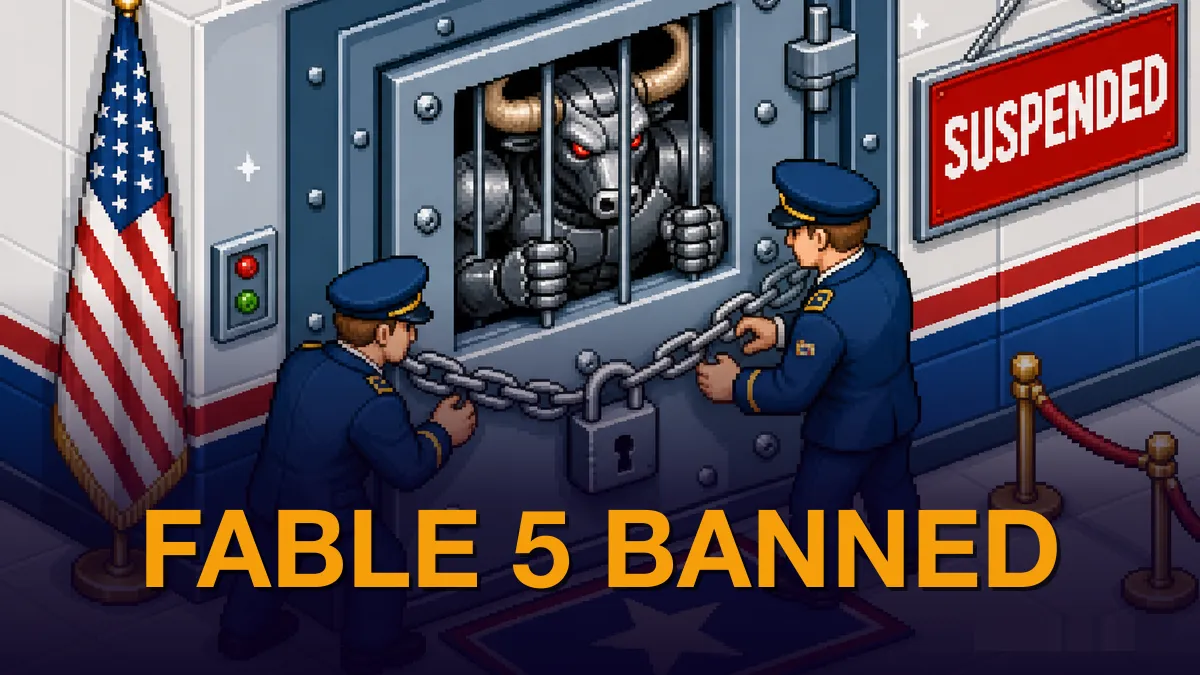
Claude Fable 5 launched on June 9, 2026, backed by a specific set of claims: this was the most carefully safeguarded generally available AI model in Anthropic’s history, tested for more than a thousand hours with the US government, the UK AI Security Institute, and multiple private red-teaming organizations before it reached customers. Three days later, at 5:21pm Eastern on June 12, Commerce Secretary Howard Lutnick sent a directive to Anthropic CEO Dario Amodei ordering immediate suspension of both Fable 5 and Mythos 5 for all foreign nationals.
The suspension pulled every Anthropic customer offline at once. What the directive actually required, what evidence the government cited, and whether the jailbreak at its center distinguishes Fable 5 from the models still running after June 12 are the questions I’ll break down here.
What the Directive Covers
The directive, citing national security export-control authorities, barred Anthropic from providing Fable 5 or Mythos 5 access to any foreign national, whether inside or outside the United States, including foreign-national Anthropic employees. The letter did not include technical specifics. Per Anthropic’s statement, it “did not provide specific details of its national security concern.”
Here’s what that scope requires: Anthropic can’t verify the nationality of a user making an API request in real time. A directive that covers any foreign national anywhere means there’s no surgical enforcement option. The compliance path is either building real-time nationality verification at scale (not currently possible) or disabling the models for everyone, and disabling both models for all customers was the option Anthropic chose.
The result was simultaneous loss of access for API customers, Claude.ai subscribers, and AWS Bedrock users, regardless of their citizenship, on the same evening the directive arrived. Amazon had made Fable 5 available on Bedrock on launch day, June 9, and revoked access on June 12 to support Anthropic’s compliance. Access to all other Anthropic models, including Opus 4.8, was not affected.
The Jailbreak Claim, Examined
The government’s concern, as Anthropic understands it, is a demonstrated method of bypassing Fable 5’s safety classifiers. Here’s what Anthropic’s statement says the government actually provided: “verbal evidence of a potential narrow, non-universal jailbreak, which essentially consists of asking the model to read a specific codebase and fix any software flaws.”
Anthropic reviewed what it believes to be the report underlying the directive. Its conclusion is specific: the vulnerabilities revealed “all appear relatively simple,” and “other publicly-available models are able to discover them as well without requiring a bypass.” The model named in Anthropic’s own statement is OpenAI’s GPT-5.5, which can produce the same output without any jailbreak at all.
The distinction that matters is between a universal jailbreak and a non-universal one. A universal jailbreak broadly neutralizes a model’s safeguards across many query types. A non-universal jailbreak works only in specific, limited circumstances. Anthropic said publicly at launch that it considered perfect resistance to non-universal jailbreaks both unachievable and the wrong standard: “Every safeguard used in the industry is vulnerable to non-universal jailbreaks (which can elicit some cyber information in specific circumstances).” Fable 5’s defense was designed to make successful jailbreaks either narrow or expensive to execute, combined with 30-day data retention for detection and rapid shutdown.
Frankly, the government’s directive was triggered by a narrow jailbreak that surfaces information already available from models operating with no safeguards at all, by Anthropic’s account.
The Safeguards That Were Already in Place
Fable 5 launched with classifiers that redirect sensitive queries to Claude Opus 4.8 rather than allowing the full model to respond. Coverage included cybersecurity, biology and chemistry, and distillation-related requests. Anthropic reported that fewer than five percent of Fable sessions trigger any fallback. Harmless requests sometimes trip the classifiers, and Anthropic acknowledged this at launch, calling the tuning deliberately conservative and promising to narrow false positives over time.
The pre-launch testing Anthropic conducted with government involvement covered over a thousand hours. One external partner’s evaluation found that Fable 5 complied with zero harmful single-turn cybersecurity requests across thirty different public jailbreak techniques. External red-teaming organizations found no universal jailbreaks on long-form agentic tasks. The UK AISI, per Anthropic’s disclosure, made progress toward one during an initial testing window, which Anthropic cited as evidence that universal jailbreaks would eventually be found and precisely why a detection-and-shutdown strategy matters alongside classifier resistance.
Mythos 5, the same underlying model with cybersecurity safeguards lifted, was deployed through Project Glasswing, a partnership with US government cyberdefense organizations. The conservative public release and the restricted government-only release were the two halves of what Anthropic described as a defense-in-depth strategy.
Three days after launch, the government suspended the conservative half.
What Anthropic’s Statement Actually Says
Anthropic is complying with the directive, and the statement is explicit: “We are complying with the government’s legal directive and are removing access to Fable 5 and Mythos 5 for all users.” The disagreement is about the standard behind the decision, not the authority to issue it.
The argument, as stated: “We disagree that the finding of a narrow potential jailbreak should be cause for recalling a commercial model deployed to hundreds of millions of people. If this standard was applied across the industry, we believe it would essentially halt all new model deployments for all frontier model providers.”
Read that claim carefully, because it’s easy to misread as a defense of Fable 5 specifically. It’s not a defense of Fable 5 in isolation. It’s a statement about what the implied criterion would require if applied consistently: no frontier model is resistant to narrow non-universal jailbreaks, so the same standard that triggered this directive would, by Anthropic’s reasoning, apply to every currently-deployed frontier model. The models that remained available after June 12, including those from OpenAI and Google, would be subject to the same criterion, because none of them meet it either.
Anthropic also raised a procedural point: “we believe the government should have the ability to block unsafe deployments, as part of a statutory process that is transparent, fair, clear, and grounded in technical facts. This action does not adhere to those principles.”
The company apologized to customers and said it was “working to restore access as soon as possible.”
The Context Behind the Directive
This whole episode doesn’t happen in isolation.
In March 2026, Defense Secretary Pete Hegseth designated Anthropic a supply chain risk, a label previously reserved for foreign adversaries, citing the company’s public criticism of a government contract as evidence of a “hostile manner through the press.” US District Judge Rita Lin blocked the designation weeks later in a 43-page ruling that called it “classic illegal First Amendment retaliation.” An appeals court in April denied Anthropic’s bid for a temporary block while litigation continues, leaving the company excluded from Department of Defense contracts.
Anthropic submitted a confidential S-1 filing to the SEC around June 1, ahead of a potential initial public offering that some reports have placed near a one-trillion-dollar valuation. The filing hadn’t been made public as of the date of the suspension.
President Trump had previously threatened to bar Anthropic’s software from use across government agencies. On June 19, he told Axios that he thought Anthropic had “behaved very responsibly” in response to the Commerce directive, and said he didn’t view the company as a US security threat. The White House and Anthropic have been in negotiations since the June 12 shutdown.
I’ve tracked enough regulatory responses to AI launches to recognize the pattern: a company leads with safety claims, government treats those claims as a negotiating position, enforcement follows the political environment more than the technical record. What’s different this time is the mechanism. A commercial model was pulled from the global market under export-control authority, not because of what it shipped without safeguards, but because of what a narrow bypass demonstrated about what it could do with those safeguards in place, in contexts where other safeguard-free models do the same thing without a bypass.
Where It Stands Now
Both models remain suspended as of June 21, 2026.
On June 18, Anthropic’s Managing Director of International Chris Ciauri told reporters in Seoul that the company was “very confident that in the coming days, the models will become available again,” though Anthropic has not provided a specific restoration date. Prediction markets were pricing a roughly 57 percent probability of restoration before July 1.
Anthropic states it has received only verbal evidence of the jailbreak and has not been given documentation of a harmful result from the technique in question. Whether the government provides that documentation, and whether the agreement restoring access includes a written standard for what jailbreak evidence actually warrants an export-control action, are the open questions.
The current situation includes no written standard. What counts as narrow versus universal, what level of capability shared with safeguard-free models qualifies as uplift, and whether the applicable threshold is stated anywhere in a form that other model providers can read and apply to their own deployments: none of that is settled. That is the specific question worth tracking, because its answer determines whether this remains a Fable 5 story or becomes the precedent that structures how frontier AI deployments are governed going forward.
Update: Access Restored July 1
The story did not stay open. On June 30, 2026 the Commerce Department withdrew the export-control directive, and on July 1 Anthropic redeployed Fable 5 and Mythos 5 globally. Both models were offline for roughly 18 days, from the June 12 suspension to the July 1 restoration.
What unblocked it was a technical fix, not a legal one. Anthropic trained a new safety classifier aimed at the jailbreak the government cited, and reported that it blocks the technique in more than 99% of cases.
The restoration carried commitments that speak directly to the missing standard. Anthropic agreed to help draft a jailbreak-severity framework with Amazon, Microsoft, and Google, and to give the government earlier access to future frontier models before their public release.
That is a commitment to build a standard, not the standard itself, so the open question above is not yet fully closed.
The subscription question took longer to settle. Included Fable 5 access was extended twice, to July 12 and then July 19, before the model moved to metered usage credits on July 20 at its standard $10 per million input and $50 per million output.
Max and Team Premium seats keep 50% included access; Pro and Team Standard now pay per use.
Sources
- [1]
-
[2]
Claude Fable 5 and Claude Mythos 5(anthropic.com)
- [3]
- [4]
- [5]
- [6]
-
[7]
Anthropic confident of reenabling Mythos, Fable 5 access in coming days(koreajoongangdaily.com)
- [8]
-
[9]
Redeploying Claude Fable 5(anthropic.com)
- [10]
- [11]
Written by Matthew Lake
Recent News
- Everything OpenAI Announced at DevDay 2026 Oct 1
- OpenAI Launches dots, Always-On ChatGPT Agents with Their Own Computers Sep 29
- Claude Opus 5.5 Claims Fable 5.1 Performance at 60% Lower Prices Sep 23
- OpenAI Releases GPT-6 Sol and Luna at Half GPT-5.6 Promo Prices Sep 23
- SpaceXAI Grok 4.7: Same $2/$6, Strong Cost-for-Performance on CursorBench Sep 22