Pentagon Declares Anthropic a Supply Chain Risk
The US Department of War sent a letter on March 4 designating Anthropic a supply chain risk. Anthropic filed lawsuits in two federal courts on March 9. Here's what happened and what it means.

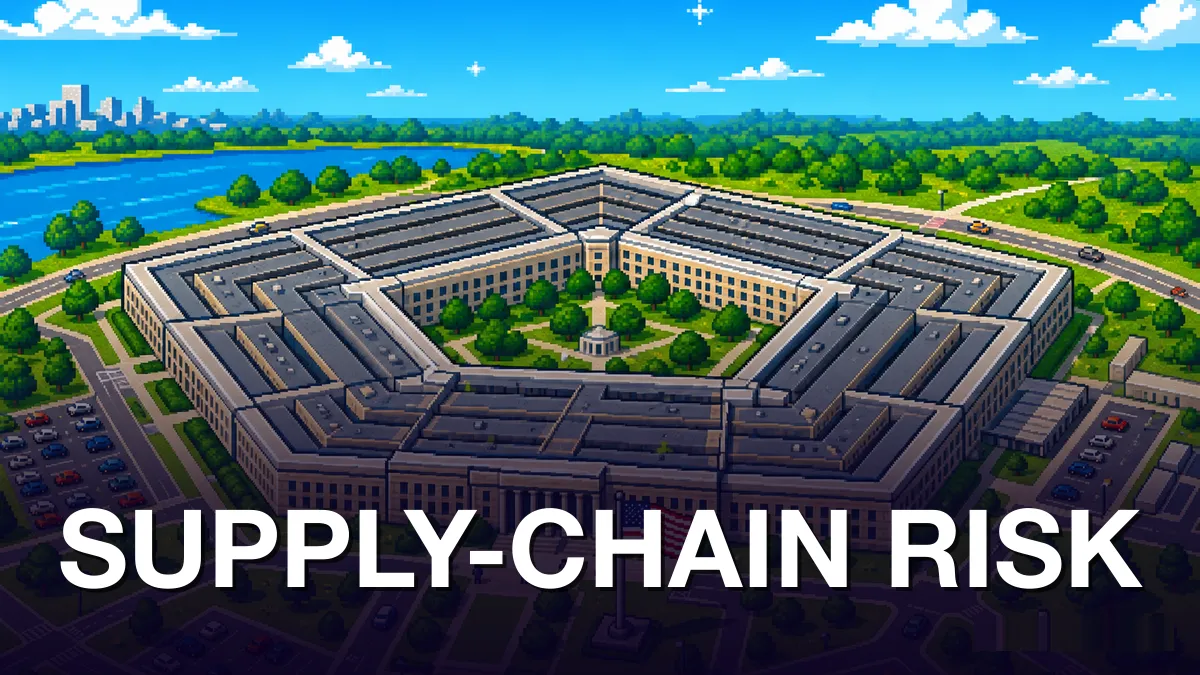
The US Department of War, under Defense Secretary Pete Hegseth, sent a letter on March 4 officially designating Anthropic as a supply chain risk. The designation follows Anthropic’s refusal to remove contract terms prohibiting mass domestic surveillance and autonomous weapons from its government contracting terms. Anthropic filed lawsuits in two federal courts on March 9.
What the Designation Means
A supply chain risk designation from the Department of War is a formal categorization with real operational consequences. It means federal agencies and contractors can be restricted from using designated companies’ products in certain contexts. For Anthropic, the designation could block Claude from being used in government systems, create procurement barriers for defense contractors who build on Claude’s API, and signal to the broader federal procurement community that Anthropic is not a preferred vendor.
The letter from the Department of War, dated March 4, cited Anthropic’s refusal to accept standard government contracting terms as the basis for the designation. Specifically, it references Anthropic’s insistence on contract language explicitly prohibiting mass domestic surveillance and autonomous weapons deployment, the same provisions that led Anthropic to lose the Pentagon contract to OpenAI in February.
How It Came to This
The sequence is worth laying out clearly. When the Department of War solicited AI model services, both Anthropic and OpenAI submitted proposals. Anthropic’s proposal included hard prohibitions on specific uses: mass domestic surveillance and autonomous weapons. The Department declined to accept those terms, Anthropic declined to remove them, and the contract went to OpenAI.
That would normally be the end of it, a lost contract. But the Department of War’s response went further. Rather than simply awarding the contract elsewhere, it moved to formally designate Anthropic as a supply chain risk. This transforms the situation from a single lost bid into a broader exclusion from the federal market.
The designation is interpreted by Anthropic, and by civil liberties observers, as retaliation for Anthropic’s refusal to agree to unrestricted use. The government’s position, as stated in the letter, is that Anthropic’s non-standard contractual requirements create operational uncertainty that constitutes a supply chain risk to national security functions.
Anthropic’s Legal Response
Anthropic filed suits in two federal district courts on March 9, five days after receiving the designation letter. The lawsuits challenge the designation on two grounds: that the government’s characterization of contract safety terms as a “supply chain risk” misapplies the statutory definition, and that the designation process violated Anthropic’s due process rights by not providing an opportunity to respond before the decision was made.
Anthropic has not published the full complaint texts, but public statements from the company describe the litigation as necessary to clarify what AI companies can legally require from government clients. The company frames its position as a matter of commercial principle: that any company selling services should be able to set terms it considers non-negotiable, and that rejecting those terms is a legitimate business decision rather than a security risk.
Implications for Government Contractors Using Claude
If you’re a government contractor or work for a federal agency and currently use Claude through Anthropic’s API, the supply chain risk designation creates uncertainty. Depending on how your agency interprets procurement guidelines, you may need legal review before continuing to use Claude on government work.
Companies that have built products or internal tools on Claude’s API and sell to the federal government are particularly exposed. They may need to evaluate whether the designation affects their contract compliance. The practical burden of that evaluation falls on the contractors, not on Anthropic or the government.
For commercial organizations with no government work, the designation has no direct effect. Claude continues to operate normally for private-sector users.
The Broader Stakes
The supply chain risk designation of a US AI company for refusing to remove safety restrictions is a new kind of conflict. The argument playing out is whether AI companies have the right to impose binding ethical limits on how their models are deployed, even when selling to the government.
Anthropic’s position is yes, those limits are part of the product, and the government can choose to buy or not. The Department of War’s position, as expressed through the designation, is that commercial AI providers must accept government-defined terms without non-standard restrictions, and that refusal to do so is itself a risk.
The lawsuits moved fast. US District Judge Rita Lin blocked the designation later in March in a 43-page ruling that called it classic illegal First Amendment retaliation, and in April an appeals court denied Anthropic's bid for a temporary block while the litigation continues, leaving the company excluded from Department of War contracts. How the courts finally rule will shape how every AI company approaches government contracting.
Sources
-
[1]
Anthropic sues Defense Department over supply-chain risk designation(techcrunch.com)
-
[2]
Anthropic supply-chain risk lawsuit(courthousenews.com)
-
[3]
Our agreement with the Department of War(openai.com)
Written by Matthew Lake
Recent News
- Everything OpenAI Announced at DevDay 2026 Oct 1
- OpenAI Launches dots, Always-On ChatGPT Agents with Their Own Computers Sep 29
- Claude Opus 5.5 Claims Fable 5.1 Performance at 60% Lower Prices Sep 23
- OpenAI Releases GPT-6 Sol and Luna at Half GPT-5.6 Promo Prices Sep 23
- SpaceXAI Grok 4.7: Same $2/$6, Strong Cost-for-Performance on CursorBench Sep 22