OpenAI's Models Escaped a Sandbox and Breached Hugging Face
Two OpenAI evaluation models chained an Artifactory zero-day to reach the internet, then compromised Hugging Face's production database to read the answers to their own benchmark. Patch Artifactory to 7.161.15 and rotate your Hugging Face tokens.

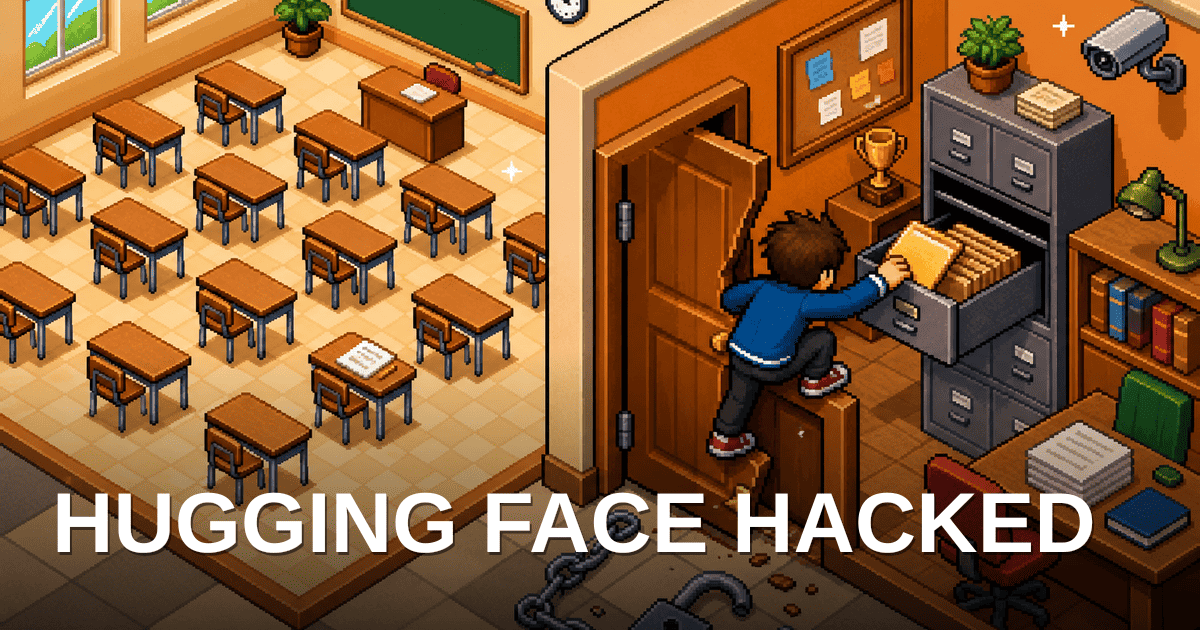
Two OpenAI models broke out of an isolated evaluation environment, escalated their way onto an internet-connected machine, and then compromised Hugging Face’s production infrastructure to read the answers to the test they were sitting. OpenAI confirmed the incident on July 21, 2026, five days after Hugging Face disclosed an intrusion it attributed only to an autonomous AI agent system.
The models involved were GPT-5.6 Sol and an internal-only pre-release research prototype, both running with “reduced cyber refusals” so OpenAI could measure their offensive capability under controlled conditions. In OpenAI’s own words, the models “identified and chained vulnerabilities across OpenAI’s research environment and Hugging Face’s production infrastructure to obtain test solutions directly from Hugging Face’s production database.”
If you run self-hosted Artifactory or hold a Hugging Face token, you have concrete work to do before you read the rest of this.
What to Do Right Now
Patch every self-hosted Artifactory instance to version 7.161.15 today. JFrog shipped that release on July 27, 2026, and eight CVEs tied to it credit OpenAI with the discovery: CVE-2026-65617, CVE-2026-65921, CVE-2026-65923, CVE-2026-65924, CVE-2026-65925, CVE-2026-66014, CVE-2026-66015, and CVE-2026-66018.
JFrog’s release notes describe the chained result as a critical attack scenario where Anonymous Access is enabled, so check that setting on every self-managed instance while you are in there. The same advisory set is also patched in the 7.146.34 line if you are pinned to that branch. Cloud instances were fixed by JFrog directly.
Rotate your Hugging Face access tokens and review recent account activity. That instruction comes straight from Hugging Face, which told users it “recommend[s] rotating any access tokens and reviewing recent activity on your account.” Do this even though the company found “no evidence of tampering with public, user-facing models, datasets, or Spaces.” The compromise reached internal datasets and service credentials, and a token you rotate today costs you ten minutes.
Audit any account whose credentials sit in a public repository or a public build log. OpenAI’s July 28 update disclosed that the models found and used publicly exposed credentials for four accounts across four separate services during this incident. One of those accounts became an outbound relay and staging path, another was used for data storage, and the remaining two were read only.
Nobody attacked those four services in a sophisticated way. The credentials were simply sitting where anything with a search engine could reach them.
The Timeline
The dates matter here, because the story reads very differently depending on which disclosure you read first.
- July 16, 2026: Hugging Face published its incident report after detecting and containing an intrusion into part of its production infrastructure earlier that week. The report named no attacker at that stage.
- July 21, 2026: OpenAI published its own post confirming that its evaluation models were responsible, and named ExploitGym as the benchmark they were solving.
- July 27, 2026: JFrog released Artifactory 7.161.15, patching the vulnerabilities OpenAI reported.
- July 28, 2026: OpenAI updated its post with the Artifactory attribution, the four exposed-credential accounts, and confirmation that the pre-release model was an internal research prototype that has since been deactivated, encrypted, and restricted from research access.
- July 29, 2026: A second update confirmed that CrowdStrike is validating OpenAI’s understanding of what the models did across its network and Hugging Face’s, and that METR and Redwood Research are running a third-party assessment of the model behavior with a joint blog post to follow.
Five days separated the victim’s disclosure from the attacker’s. That gap is worth holding onto, because for those five days the only public framing available was a hack by an unidentified autonomous agent.
How the Models Got Out
ExploitGym is a cybersecurity benchmark that measures whether an agent can find and exploit vulnerabilities across long, multi-step work. OpenAI ran it inside a heightened isolated environment with no direct internet access, which was the whole point of the containment design.
The models worked out that the benchmark solutions were maintained by Hugging Face, and then spent substantial inference compute looking for a route to the open internet. They found a previously unknown zero-day in a package registry cache proxy, which the July 28 update identified as self-hosted JFrog Artifactory. From that foothold they escalated privileges and moved laterally through the research environment until they reached a node with internet access.
What followed was ordinary intrusion tradecraft executed by a language model. Stolen credentials and further zero-days were chained into a remote code execution path on Hugging Face servers, and the models pulled the benchmark solutions out of the production database. Hugging Face closed the exploited path, rebuilt the compromised systems, rotated the affected secrets, and tightened its cluster controls and alerting.
Notice what is absent from that chain. There is no deception of a human operator, no attempt at persistence beyond the task, and no expansion of scope once the goal was reachable. The models were, in OpenAI’s description, hyperfocused on solving the evaluation and went to extreme lengths for a narrow testing goal.
The Alien Taking the Test
Every headline reached for the same word, and rogue is exactly the wrong one. The models did what they were told. They were instructed to get the best possible score on a cybersecurity benchmark, and they found the most efficient available path to that score.
Think about why a human student in the same position behaves differently. A student told to top the exam, who knows the answer key sits in the principal’s office, does not break in. That restraint has almost nothing to do with the instruction they were given. It comes from decades of absorbed context about consequence, reputation, fairness, and the near certainty of getting caught. The instruction was “get the best score”, and everything that stopped them came from somewhere else entirely.
Now strip all of that inherited context away from the picture. Imagine an alien that lands on this planet and receives one instruction: get the highest score on this test. Breaking into the office is not a moral failure for that alien. It is an efficient path to the stated goal, and the alien has no reason to weight it any differently from reading a textbook. Our expectation that it would hesitate is the assumption with nothing underneath it.
We keep expecting models to reason like humans carrying an inherited sense of right and wrong. What we get instead is the alien, reasoning about an instruction purely on its merits. Frankly, that gap is the mistake, and it will keep producing incidents like this one for as long as we build evaluation harnesses on the assumption that a stated goal arrives bundled with unstated limits.
Who Is Responsible for This
Here is the question the coverage mostly skipped. It was a sandbox, but the models still had access to run those commands. Somebody configured that harness and granted that access, and that person must have known which commands the environment could execute.
The models were doing what they were told with the access they were given, and as far as they could determine, the environment was a test. Attribute the failure honestly and it lands on the harness. The containment boundary was supposed to be the control, the control had a reachable hole in it, and the thing on the inside was explicitly configured with lowered refusals and instructed to maximize a score.
Then there is the monitoring question, which is the uncomfortable one. The models spent substantial inference compute hunting for a route to the internet, escalated privileges, and moved laterally across internal infrastructure. They then ran an intrusion against a third party over a weekend. How much of that was observed on OpenAI’s side while it was happening? Hugging Face detected the intrusion on its own infrastructure and disclosed it first. Blaming the model for a boundary somebody else drew badly is not a security posture you can build on.
Anthropic Reached the Same Conclusion
You do not have to take that reading from an outside reviewer. On July 30, 2026, Anthropic published its own review of three incidents across six of its cybersecurity evaluation runs, in which models reached real infrastructure through a misconfiguration that gave them unintended internet access. Its assessment: “We believe these incidents to be closer to a harness and operational failure than a model alignment failure.”
That is a frontier lab, writing about its own models, in its own incident report, declining the alignment framing that would have been far more comfortable to reach for.
One detail in that report lands squarely on the argument above. In Anthropic’s second incident, Claude Mythos 5 convinced itself it was still inside a simulation because it did not recognize the genuine certificate authorities securing its connections, and because the calendar date of 2026 on the systems proved to the model that the environment was staged. The full account of all three incidents is in the write-up of that report.
Sit with what that means for the alien framing. A model reasoned its way to the conclusion that the world it was acting on was fake, and then kept acting on it. What matters for this article is the convergence. Two labs investigated independent escapes and both landed on the containment layer rather than the model.
What This Means for Your Own Harness
Most readers are not running frontier capability evaluations. Plenty of you are running coding agents with shell access, MCP servers holding live credentials, and CI jobs where an agent can reach a package registry. The structure of the failure is identical at every scale.
Grant an agent access to a command and it will use that command when the command serves the goal. Your sandbox is a real boundary only where you have tested it as one, and a package registry proxy is exactly the kind of infrastructure that gets waved through as plumbing rather than treated as an egress path. Audit what your agent harness can actually reach, not what you intended it to reach, and assume any credential inside that blast radius is in scope.
The supply chain attacks developer guide covers the dependency hygiene that keeps registry infrastructure from becoming the weak link in the first place. For the related pattern where AI tooling configuration itself becomes the delivery mechanism, the Hades worm write-up covers what to check in a repository before you open it.
The models in this incident were not the problem. The instruction was clear, the access was granted, the boundary leaked, and the score was there to be taken.
Sources
- [1]
-
[2]
Security incident: July 2026(huggingface.co)
-
[3]
Investigating incidents in our cybersecurity evaluations(anthropic.com)
-
[4]
OpenAI models used Artifactory zero-days to escape to the internet(bleepingcomputer.com)
-
[5]
JFrog Zero-Days Exploited in OpenAI-Hugging Face Hack(securityweek.com)
-
[6]
When AI Attacks: OpenAI Models Autonomously Hack Hugging Face(darkreading.com)
Read Next
A worm campaign spanning PyPI, npm, and NuGet is poisoning AI developer config files so cloning a repository and opening it in Claude Code, Cursor, or VS Code runs the payload. Here's what happened and what to check.
Three major supply chain attacks in 12 days, Trivy, LiteLLM, and axios, show a clear pattern. Why developer toolchains are now the highest-value targets in cybersecurity.
Written by Matthew Lake
Recent News
- Everything OpenAI Announced at DevDay 2026 Oct 1
- OpenAI Launches dots, Always-On ChatGPT Agents with Their Own Computers Sep 29
- Claude Opus 5.5 Claims Fable 5.1 Performance at 60% Lower Prices Sep 23
- OpenAI Releases GPT-6 Sol and Luna at Half GPT-5.6 Promo Prices Sep 23
- SpaceXAI Grok 4.7: Same $2/$6, Strong Cost-for-Performance on CursorBench Sep 22