Claude Opus 4.8: Anthropic's New Flagship Lands with Parallel Subagents
Anthropic released Claude Opus 4.8 on May 28, 2026: same $5/$25 pricing, a research-preview dynamic workflows tool for parallel subagents in Claude Code, a 3x-cheaper fast mode, and measurable alignment gains.

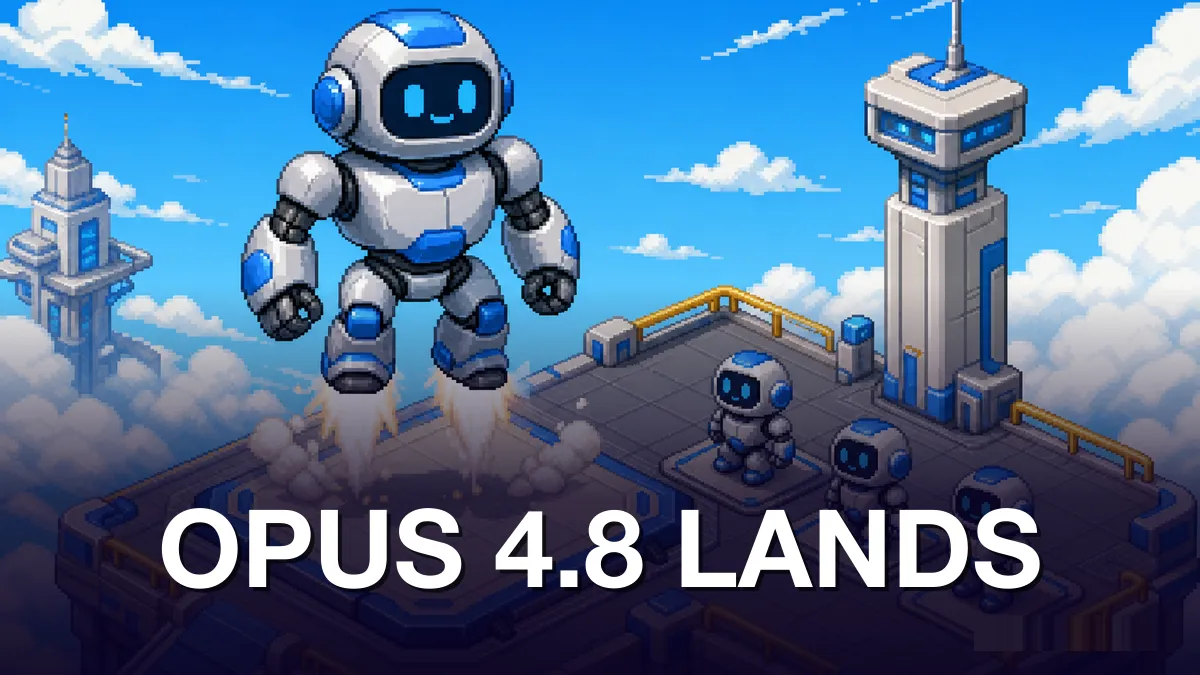
Anthropic released Claude Opus 4.8 on May 28, 2026, and it keeps the same price as Opus 4.7 and 4.6, $5 per million input tokens and $25 per million output tokens, so the headline isn’t a benchmark chart. It’s a set of operational changes that affect how you actually run the model day to day.
Update (July 2026): Anthropic released Claude Opus 5 as its new flagship on July 24, 2026, holding the same $5/$25 standard price with what it describes as roughly double Opus 4.8’s agentic performance. The reporting below reflects Opus 4.8 as it stood at launch.
Dynamic Workflows: Parallel Subagents in Claude Code
The addition that stands out is dynamic workflows, shipping as a research preview in Claude Code. It lets a single run fan out into parallel subagents. Instead of one agent working through a task linearly, Opus 4.8 can spin up several at once and coordinate their results. For anything that decomposes naturally (reviewing a diff across multiple dimensions, migrating a pattern across many files, researching several angles at once), that’s the difference between waiting on a single sequential pass and getting concurrent work back.
Two API-level changes back this up, and both matter for long agent runs. The Messages API now accepts system entries mid-conversation without breaking the prompt cache, so a long agent session can adjust its instructions partway through without throwing away cached context. And “effort control” landed in claude.ai and Cowork, letting you dial how much reasoning the model spends on a given response.
A Cheaper Fast Mode
Opus 4.8 keeps the optional fast mode that trades cost for speed, but the price dropped sharply. Fast mode now runs at $10 per million input tokens and $50 per million output, roughly three times cheaper than the $30/$150 fast-mode rate on Opus 4.6 and 4.7. Standard inference stays at $5/$25, so fast mode is now a far easier call when latency matters.
Reliability and Alignment
Anthropic’s framing leans on reliability rather than raw capability. The release notes describe Opus 4.8 as “around four times less likely than its predecessor to allow flaws in code,” and the alignment assessment reports new highs on measures of prosocial behavior. For developers handing more work to autonomous agents, fewer silently-wrong patches matters more than another point on a leaderboard.
On agentic evaluations the model does post real gains: it scored 84% on Online-Mind2Web (Anthropic’s strongest computer-use and browser-agent result to date) and it’s described as the first model to break 10% overall on the all-pass standard of the Legal Agent Benchmark. Third-party trackers report around 88.6% on SWE-bench Verified, up modestly from Opus 4.7.
Pricing and Availability
Pricing is unchanged from the last two Opus releases: $5/$25 per million tokens at standard rates, with the full 1M-token context window billed at the standard per-token rate. Opus 4.8 is available in claude.ai for Pro, Max, Team, and Enterprise users, in Claude Code, on the Claude API as claude-opus-4-8, and through Amazon Web Services, Google Cloud, and Microsoft Foundry.
What It Means for Developers
Notice what Anthropic chose to lead with: this is a flagship update where the marquee features are workflow and reliability changes, not a bigger context window or a flashy benchmark jump. Parallel subagents change what a single Claude Code run can take on, the cheaper fast mode makes latency-sensitive agents practical, and the reliability gains reduce the review burden on AI-generated code. If you’re already on Opus 4.7, the upgrade costs nothing extra to try: same price, same context window, with the new tooling available immediately.
Sources
-
[1]
Introducing Claude Opus 4.8(anthropic.com)
-
[2]
Claude API Pricing(platform.claude.com)
-
[3]
Claude Opus 4.8 is now available on AWS(aws.amazon.com)
-
[4]
Introducing Claude Opus 5(anthropic.com)
- [5]
Written by Bobby Smart
@mrbobbysmartRecent News
- Everything OpenAI Announced at DevDay 2026 Oct 1
- OpenAI Launches dots, Always-On ChatGPT Agents with Their Own Computers Sep 29
- Claude Opus 5.5 Claims Fable 5.1 Performance at 60% Lower Prices Sep 23
- OpenAI Releases GPT-6 Sol and Luna at Half GPT-5.6 Promo Prices Sep 23
- SpaceXAI Grok 4.7: Same $2/$6, Strong Cost-for-Performance on CursorBench Sep 22