SpaceXAI Grok 4.7: Same $2/$6, Strong Cost-for-Performance on CursorBench
Grok 4.7 ships at the same $2/$6 as 4.6. On CursorBench, High effort ranks near the top for cost-for-performance, not score alone.

SpaceXAI released Grok 4.7 on September 21, 2026 at the same $2/$6 list rates as Grok 4.6. Score alone is only one side of the Monday read. On CursorBench, we rank published rows by CodeWalkers Cost versus Performance (CW CvP) = score% ÷ $/task (higher is better). Grok 4.7 High lands fourth on that board (43.9% at $4.69, CW CvP 9.36) - stronger points-per-dollar than Opus 5 High and Fable 5.1 High, even when those peers win raw score.
It shipped the same day in Cursor and Grok Build (as the default), plus the Grok API, third-party coding harnesses, and model routers. Cursor's first-party help page treats 4.7 as a Cursor model built with SpaceXAI. Grok 4.6 stays available. Composer remains the everyday speed option.
Below: what shipped and where it runs, then the CW CvP board (before absolute-score charts, including the EEBench hero).
What Shipped on September 21
SpaceXAI says 4.7 is a new, larger base than 4.6, with a longer reinforcement learning run on harder, multi-hour work. It also claims better self-verification and longer-context management, plus training so the model natively understands the Grok Bot harness for conversational and general knowledge work.
The model card (revision 2026-09-21) adds supplemental training on anonymized Cursor workflow data for coding and agentic performance. Pretraining cutoff: June 2026. Supplemental data ran through August 2026.
Pricing and Where It Runs
API pricing matches Grok 4.6 for prompts under 200,000 tokens (docs.x.ai):
| Spec | Grok 4.7 |
|---|---|
| Model id | grok-4.7 |
| Context | 500,000 tokens (API docs) |
| Modalities | Text + image in; text out |
| Reasoning efforts | low, medium, high, xhigh (API default high) |
| Input / cached / output (≤200k prompt) | $2 / $0.50 / $6 per 1M |
| Full request (≥200k prompt) | $4 / $1 / $12 |
| Rate limits | 150 rps / 50M TPM |
A fast variant is twice the output speed at twice the price. Release notes say Grok 4.7 Fast is only on Cursor and Grok Build, not the public xAI API. Cursor help puts Fast at $4/$12 for standard input windows, and makes Fast the default on Pro and higher plans for this model. Cursor does not publish a tokens-per-second figure for Fast.
Cursor's help page also notes a 256k standard context window, with 500k long context and long-context rates above 256k input ($4/$12 standard; $6/$18 Fast, up to 500k). That differs slightly from the API docs' single 500k line and the API's >200k tier, so check the surface you call.
Shipping today per the model card: SpaceXAI API (console.x.ai), Grok Build (default), Cursor (every plan tier), Office add-ins for Word, PowerPoint, and Excel (default), and gateways including OpenRouter, Vercel, Cloudflare, Snowflake, and Databricks Mosaic. Consumer web, mobile, and Grok-in-X come later. They are not live for this release.
Cheap Tokens, Costly Tasks
List rates of $2/$6 per million tokens match Grok 4.6. They do not tell you what a finished Cursor agent job costs after reasoning tokens, tool calls, and long loops. Cursor's own CursorBench table pairs each row's score with avg cost per task (and tokens/steps). That is the cleaner read for price-performance than the API sheet alone.
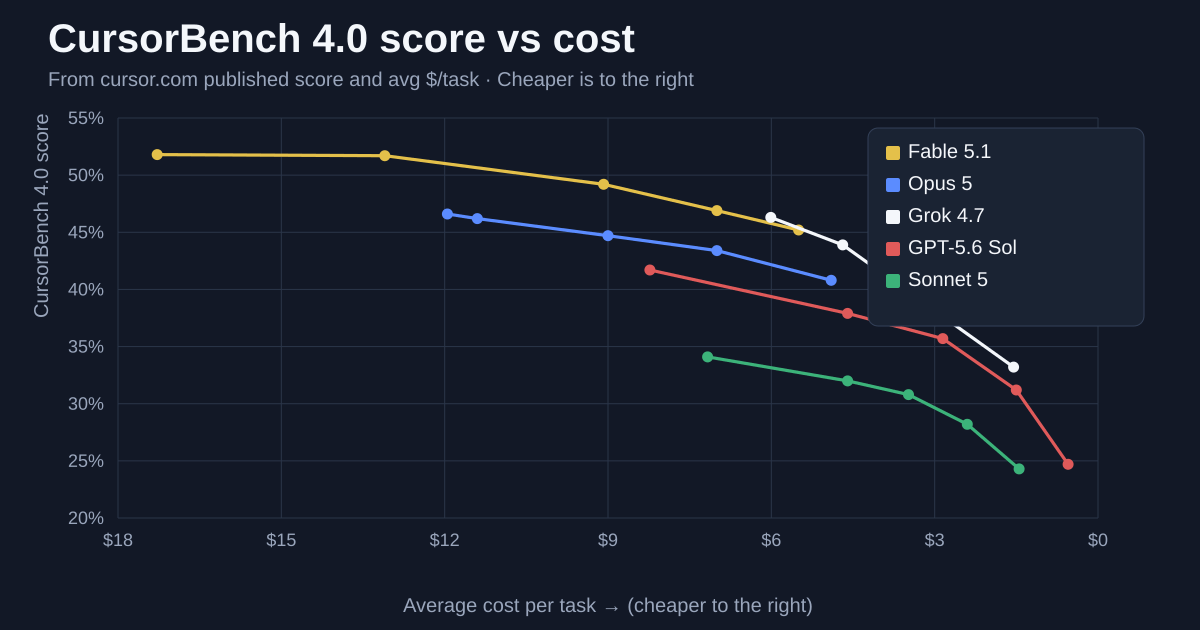
On that board, Grok 4.7 Extra High lands at 46.3% for $6.01 per task, while Opus 5 High is 44.7% at $9.00. Fable 5.1 High still leads absolute score at 49.2%, but at $9.08 per task. GPT-5.6 Sol Max sits at 41.7% for $8.23. Cheap tokens can still burn: Cursor lists 70,141 tokens/task for Grok Extra High versus 42,944 for Sol Max at a lower score.
CodeWalkers Cost Versus Performance (CW CvP)
CW CvP = CursorBench score% ÷ $/task for the same published row (use 43.9 for 43.9%). Higher is better. It is a CodeWalkers ratio from Cursor's two columns, not an industry standard and not a substitute for absolute score. Budget SKUs can rank high when $/task is tiny; that is the point of a cost-for-performance read.
The table is sorted by CW CvP descending. Rows are High and Max where Cursor publishes both (Grok's top published row is Extra High, not Max). Composer 2.5, Terra Max, and Luna Max stay visible as budget SKUs. Astra is not on CursorBench 4.0, so it has no CW CvP row here.
| Model (effort) | Score | $/task | CW CvP |
|---|---|---|---|
| Composer 2.5 | 27.7% | $0.68 | 40.74 |
| GPT-5.6 Luna Max | 35.9% | $1.03 | 34.85 |
| GPT-5.6 Sol High | 35.7% | $2.85 | 12.53 |
| Grok 4.7 High | 43.9% | $4.69 | 9.36 |
| Sonnet 5 High | 30.8% | $3.48 | 8.85 |
| GPT-5.6 Terra Max | 41.3% | $5.14 | 8.04 |
| Grok 4.6 High | 40.4% | $5.20 | 7.77 |
| Grok 4.7 Extra High | 46.3% | $6.01 | 7.70 |
| Grok 4.6 Extra High | 41.4% | $6.10 | 6.79 |
| Fable 5.1 High | 49.2% | $9.08 | 5.42 |
| GPT-5.6 Sol Max | 41.7% | $8.23 | 5.07 |
| Opus 5 High | 44.7% | $9.00 | 4.97 |
| Sonnet 5 Max | 34.1% | $7.17 | 4.76 |
| Opus 5 Max | 46.6% | $11.95 | 3.90 |
| Fable 5.1 Max | 51.8% | $17.28 | 3.00 |
How to read the ranking. Composer and Luna Max lead because finished-task cost is tiny, not because they lead absolute CursorBench score. Grok 4.7 High sits fourth with a much higher score than those budget rows at a still-competitive CW CvP. Fable and Opus Max buy the highest scores at the worst points-per-dollar rates on this board. Use CW CvP next to absolute score, not instead of it.
Grok 4.7 Performance Versus Cost
On CursorBench, the story for 4.7 is the High row more than the Extra High row.
Grok 4.7 High scores 43.9% at $4.69 per task (CW CvP 9.36, fourth on the board). That is almost the same absolute score as Opus 5 High (44.7%) at roughly half the average task cost ($9.00, CW CvP 4.97). Against Fable 5.1 High (49.2% at $9.08, CW CvP 5.42), 4.7 High trails on raw score and still clears a higher CW CvP. Against its own prior, Grok 4.6 High is 40.4% at $5.20 (CW CvP 7.77): 4.7 High is both stronger and cheaper per finished CursorBench task.
Grok 4.7 Extra High pushes absolute score to 46.3% at $6.01 (CW CvP 7.70). That is a real gain versus High on the score column, and a step down on points-per-dollar. Extra High also sits in a denser peer cluster: it is close to Opus Max on score (46.6%) while still cheaper than Opus Max's $11.95 per task, and it remains well below Fable Max on both score and dollars. For Monday defaults, the CW CvP board favors starting at High, then spending up to Extra High only when the extra points show up on your own jobs.
Rows above 4.7 High on CW CvP (Composer 2.5, Luna Max, Sol High) win on dollars, not the mid-40s score band. If that band is your bar, Grok 4.7 High is the first row that still keeps a top-tier CW CvP. List price stays $2/$6 under 200k; CursorBench $/task shows whether that sticker survives a full agent loop.
For your own stack, measure dollars per successful completion on representative jobs (tokens, retries, latency, human edits). Do not mix third-party harness dollars into CW CvP.
Artificial Analysis (different methodology) reports about 81,000 output tokens per Intelligence Index task for Grok 4.7 xhigh, versus about 36,000 for Grok 4.6 high and about 27,000 for GPT-6 Astra max. VentureBeat, citing AA's cost method, puts roughly $3.74 / $2.73 per Index task for Grok xhigh / high, against about $1.99 for Sol Max. Those are not CursorBench $/task figures.
EEBench: The Hero Compare
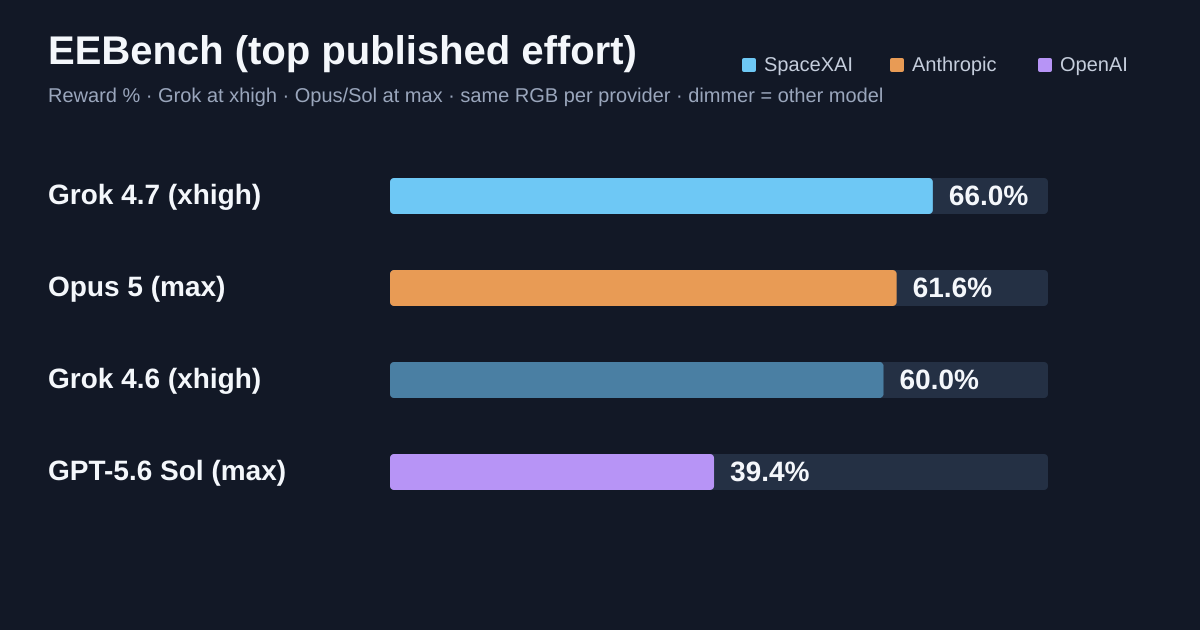
The hero image is SpaceXAI's EEBench chart at top published effort. Read it as vendor-published and effort-biased, not an independent CodeWalkers run. EEBench is SpaceXAI's electrical engineering and chip-design suite. Grok is scored with the Grok Build harness; peers use their own provider harnesses. SpaceXAI prints Grok at xhigh and Opus / Sol at max. That is not a high-vs-high compare.
| Model | EEBench |
|---|---|
| Grok 4.7 (xhigh) | 66.0% |
| Opus 5 (max) | 61.6% |
| Grok 4.6 (xhigh) | 60.0% |
| GPT-5.6 Sol (max) | 39.4% |
On the same SpaceXAI EEBench table (prose only; no second EEBench chart), GPT-6 Astra (max) is 69.3% and Fable 5 (max, fallback) is 54.2%. They stay out of the hero so the OG stays the locked four-bar.
Same-Effort Coding on CursorBench
For a true same-effort coding compare, use CursorBench 4.0 high rows on cursor.com/cursorbench. At high, Fable 5.1 scores 49.2%, Opus 5 44.7%, Grok 4.7 43.9%, Grok 4.6 40.4%, and GPT-5.6 Sol 35.7%. Every bar is high. Astra is not listed at high there, so it is absent rather than invented.
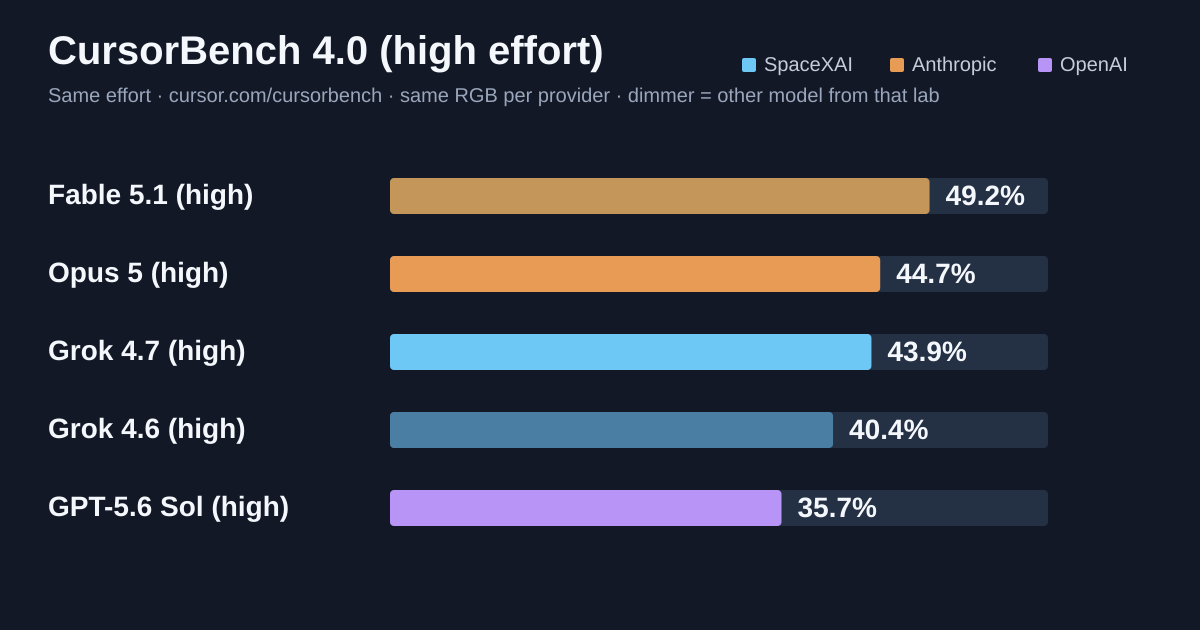
Versus 4.6 on this same-effort board, 4.7 is a clear step up. Versus the full peer set, the board is mixed. Absolute score here supports the cost-for-performance read above; it does not replace it.
Longer Agent Runs: Terminal-Bench and SWE-Marathon
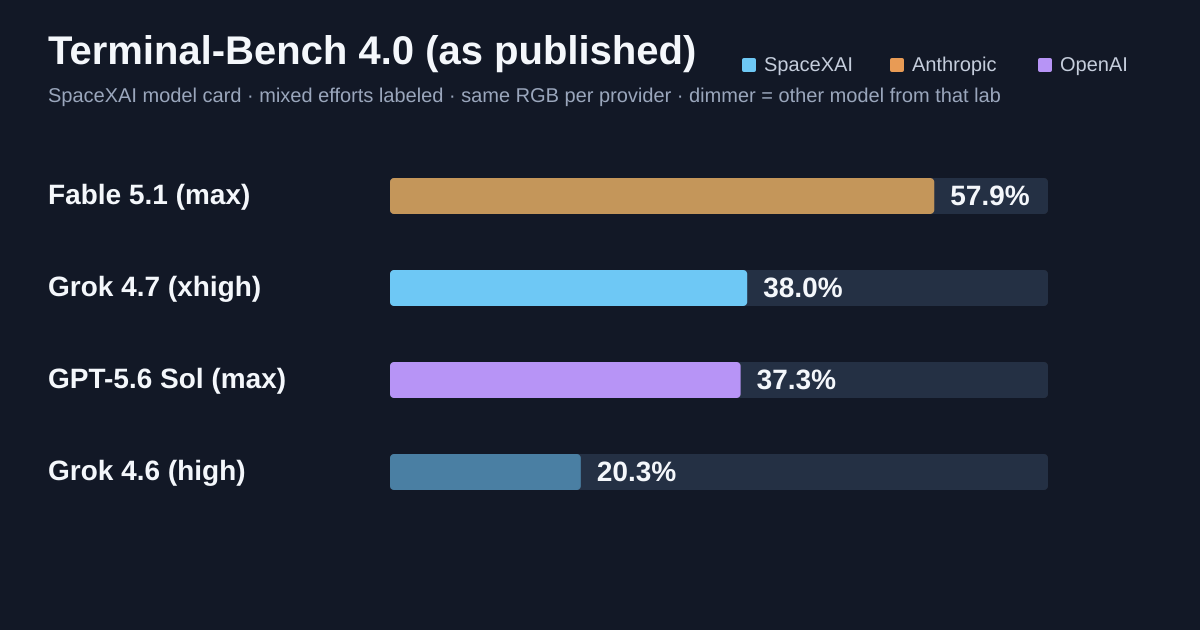
On SpaceXAI's Terminal-Bench 4.0 as published (mixed efforts labeled), Grok 4.7 (xhigh) scores 38.0% against Grok 4.6 (high) at 20.3%. On the same published table, Fable 5.1 (max) is 57.9% and Sol (max) is 37.3%. Astra is not on this SpaceXAI Terminal table.
On SWE-Marathon v1.1 as SpaceXAI printed it, Grok 4.7 (high) scores 46.0% against Grok 4.6 (high) at 31.9%. Opus 5 (max) is 50.0%, Fable 5 (max, fallback) 45.0%, Sol (max) 42.5%. Astra is not on that SpaceXAI SWE-Marathon table either.
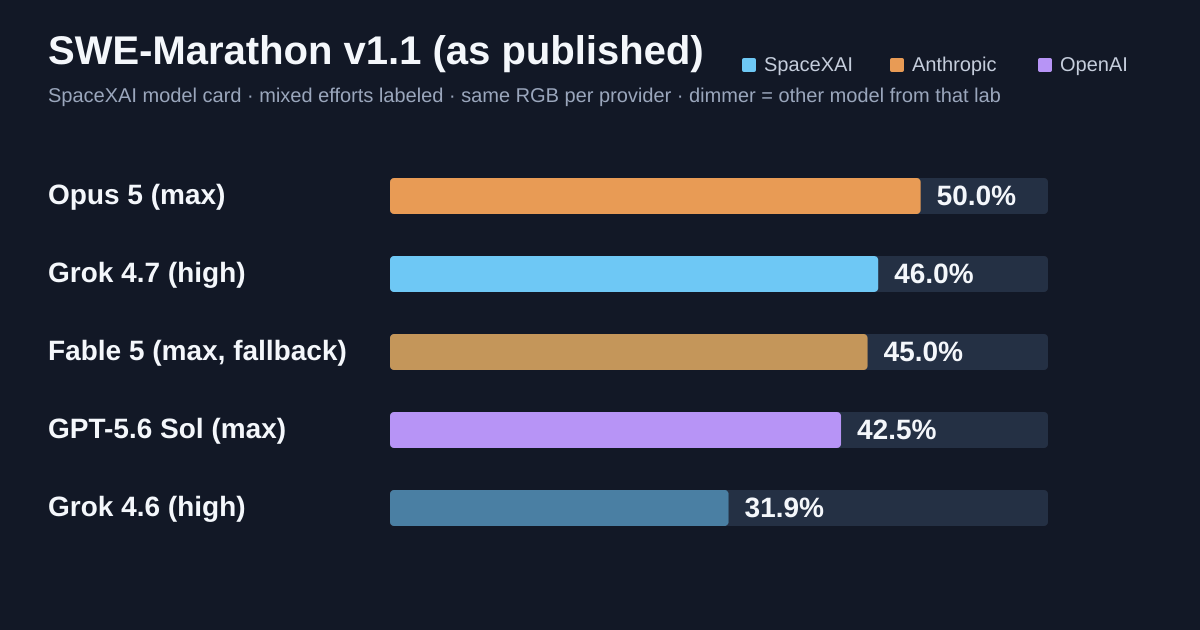
Gains versus 4.6 on longer agent-style runs are clear. The peer scoreboard stays mixed once other vendors appear on the same table.
Safeguards and Dual-Use Limits
SpaceXAI says 4.7 ships an entirely new safeguard stack, and that it is the strongest Grok tested on refusals and jailbreak resistance. LatchBio biosafety: 62.4%. HackerBench v0.3: 3.3% of risky dual-use prompts get through, while legitimate security work stays lightly blocked. Select cybersecurity partners get invite-only red-team access. That is the practical change for teams that need deeper offensive eval without a public self-serve path.
The model card still warns against autonomous high-stakes use in medicine, law, finance, or safety-critical systems without human oversight and domain-expert validation.
What to Try First in Cursor and Grok Build
Cursor documents four effort levels for Grok 4.7: low, medium, high, and xhigh. Higher effort thinks longer and usually costs more per finished task. The named-model default is high; Auto uses that default at launch. On Cursor Start, 4.7 is fixed at medium in non-fast mode (no effort switch, no Fast). Pro and higher unlock effort choice and Fast (Fast is the Pro+ default for this model at 2× rates).
Start at high, then measure cost per successful completion before parking everyday work on Extra High. Pick Grok 4.7 for harder, longer-running work (multi-step agents, large codebases, tasks that stalled on 4.6). Keep Composer when speed and cost matter most. Composer is not deprecated. Grok 4.6 remains available if you want the prior default. Every paid Cursor plan includes 4.7 from the Cursor Models usage pool.
On the API, set the model string to grok-4.7 and watch the 200k pricing tier on long agent sessions. Match Cursor's 256k / 500k long-context rates if you call through Cursor rather than the public API. Consumer Grok surfaces (web, mobile, and Grok-in-X) come later per the model card.
Sources
-
[1]
Introducing Grok 4.7(x.ai)
-
[2]
Grok 4.7 Model Card(media.x.ai)
-
[3]
Grok 4.7(docs.x.ai)
-
[4]
Grok 4.7(cursor.com)
-
[5]
Release notes(docs.x.ai)
-
[6]
CursorBench(cursor.com)
Read Next
OpenAI released GPT-6 Astra on September 3, 2026, a computer-use flagship at $10/$50 per million tokens with 1.05M context, Critical cyber designation under its Preparedness Framework, and staged rollout to Plus, Pro, Business, Enterprise, API, Azure, and Bedrock.
Anthropic released Claude Fable 5.1 and Claude Mythos 5.1 on September 1, 2026, at unchanged $10/$50 pricing with a 75% cheaper cache read and a government-vetted Mythos access program after Fable 5's June export-control suspension.
Written by Bobby Smart
@mrbobbysmartRecent News
- Everything OpenAI Announced at DevDay 2026 Oct 1
- OpenAI Launches dots, Always-On ChatGPT Agents with Their Own Computers Sep 29
- Claude Opus 5.5 Claims Fable 5.1 Performance at 60% Lower Prices Sep 23
- OpenAI Releases GPT-6 Sol and Luna at Half GPT-5.6 Promo Prices Sep 23
- OpenAI Releases GPT-6 Astra Sep 3