Claude Opus 5.5 Claims Fable 5.1 Performance at 60% Lower Prices
Anthropic says Opus 5.5 performs at Fable 5.1's level for $4/$20 per million tokens. On CursorBench, default Opus 5.5 matches Fable at max for a sixth of the cost.


Anthropic released Claude Opus 5.5 on September 22 with a pitch aimed squarely at anyone paying for Fable 5.1. Anthropic says the new model "performs at the level of Claude Fable 5.1 on most work", and it lists at $4 input and $20 output per million tokens, which is 60% below Fable 5.1's $10 and $50.
You may also see "40% cheaper" in Anthropic's announcement. That figure compares Opus 5.5 with the older Opus 5, not with Fable, so this report uses the 60% gap to Fable as its headline number.
It arrived in a crowded week, alongside GPT-6 Sol and Luna and a day after Grok 4.7. No single benchmark covers every one of these models yet, so this report pieces the comparison together from published results. CodeWalkers hasn't run a controlled test of our own.
What Anthropic Claims
Anthropic's launch post breaks the saving into three parts:
- Token prices: input and output drop 20% against Opus 5, from $5 and $25 to $4 and $20.
- Cache reads: down 60% to $0.20 per million. Anthropic says cache reads "make up the majority of agentic and coding work costs".
- Total cost: about 40% less than Opus 5 on typical workloads at default settings, with output more than 30% faster.
The post also gives one head-to-head task. Opus 5.5 and Fable 5.1 each translated HAProxy, the load-balancing software, from C into Rust. Both rewrites passed nearly all of HAProxy's regression tests. Opus 5.5 finished in 9.5 hours against 12 for Fable 5.1, at 51% lower cost.
Anthropic adds a caveat of its own, saying benchmark margins have become a less reliable guide at this level, and that in its own use "the gap between Opus 5.5 and Claude Fable 5.1 is narrower than these scores suggest." Read the tables below with that in mind.
Prices and Availability
The Opus 5.5 model documentation lists claude-opus-5-5, a one-million-token context window, and 128,000 maximum output tokens. Adaptive thinking is always on, with medium as the default effort. It runs on the Claude API, Amazon Bedrock, Google Cloud, Microsoft Foundry, and Claude Platform on AWS. GitHub Copilot is rolling it out gradually to Pro+, Max, Business, and Enterprise users.
| Model | Input | Cached | Output |
|---|---|---|---|
| Opus 5.5 | $4 | $0.20 | $20 |
| Opus 5 | $5 | $0.50 | $25 |
| Fable 5.1 | $10 | $0.25 | $50 |
| GPT-6 Sol | $2 | $0.20 | $10 |
| GPT-6 Astra | $10 | $1 | $50 |
Standard API prices in USD per million tokens. Cached means cache reads; cache writes are billed separately. OpenAI prices use its short-context tier from the API pricing page.
Against Fable 5.1, Opus 5.5 is 60% cheaper for fresh input and output but only 20% cheaper for cache reads. Five-minute cache writes cost $5 per million tokens. Fast mode, a research preview in Claude Code and the Claude Platform, costs $8 input and $40 output for up to 2.5 times the speed. Anthropic is also raising five-hour usage limits on Pro, Max, Team, and seat-based Enterprise plans.
Cursor's Benchmark Puts a Number on It
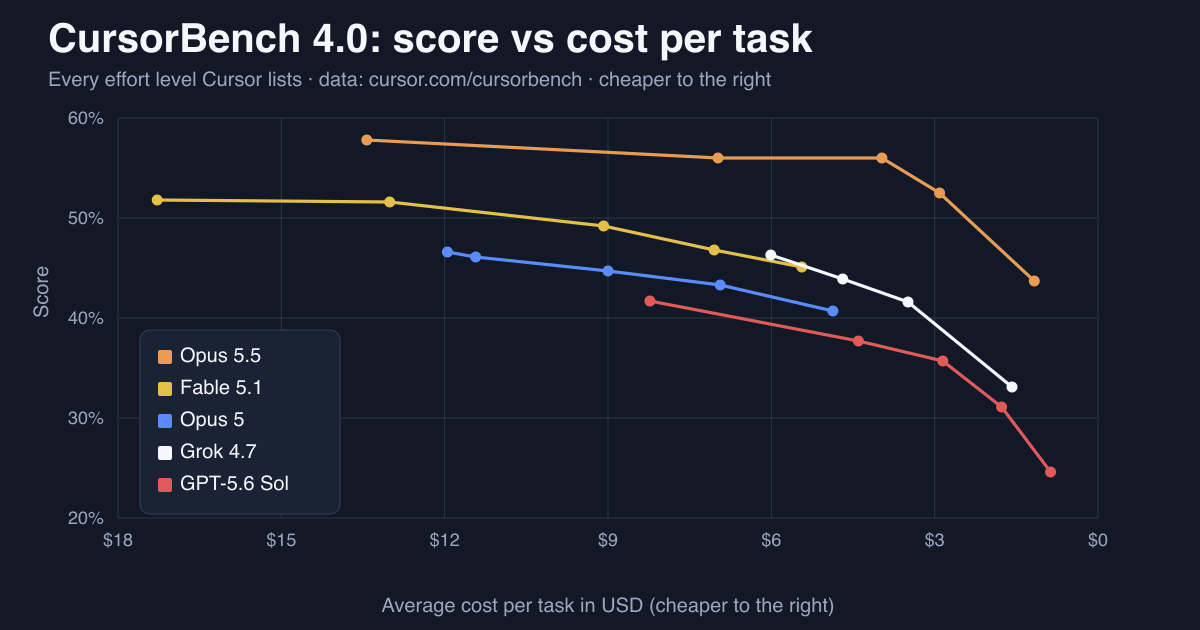
CursorBench 4.0 is Cursor's own test of ambiguous, multi-file coding tasks. It publishes both a score and an average cost per task for every effort level. It is the one coding table that already lists Opus 5.5, Fable 5.1, and Grok 4.7 side by side.
| Model (effort) | Score | $/task |
|---|---|---|
| Opus 5.5 (max) | 57.8% | $13.43 |
| Opus 5.5 (high) | 56.0% | $3.97 |
| Opus 5.5 (medium) | 52.5% | $2.91 |
| Fable 5.1 (max) | 51.8% | $17.28 |
| Fable 5.1 (high) | 49.2% | $9.08 |
| Grok 4.7 (xhigh) | 46.3% | $6.01 |
| GPT-5.6 Sol (max) | 41.7% | $8.23 |
At its default medium effort, Opus 5.5 edges past Fable 5.1 at max effort for about a sixth of the cost per task. At high effort it scores 4.2 points more than Fable's best for under a quarter of the price. That is the clearest support yet for Anthropic's Fable claim, and it comes from Cursor rather than Anthropic.
Cursor hasn't added GPT-6 Sol or Astra yet, so the OpenAI line in the chart is the previous GPT-5.6 Sol.
Anthropic's Launch Table
Anthropic's own results put Opus 5.5 ahead of Fable 5.1 on every coding and knowledge-work test it published:
| Benchmark | Opus 5.5 | Fable 5.1 | Astra |
|---|---|---|---|
| Terminal-Bench 4.0 | 66.4% | 55.8% | 57.9% |
| FrontierCode v1.1 | 54.4% | 50.3% | 53.3% |
| GDPval-AA v2.1 (Elo) | 1846 | 1735 | 1542 |
| OSWorld 2.0 | 81.8% | 80.7% | Not listed |
Scores are as Anthropic published them, with FrontierCode using its Main set and OSWorld reported as a partial run. Anthropic enabled production safeguards and used fallback models when they intervened. Those setup differences limit what we can attribute to the model alone.
Anthropic also says that at default effort, Opus 5.5 beats Astra on FrontierCode for roughly 20% of the cost per task. On Terminal-Bench it matches Astra for about 40% of the cost. Both are vendor cost figures we can't check independently.
Opus 5.5 vs Sol and Astra
Anthropic's table compares against the older GPT-5.6 Sol, so it can't settle the newer GPT-6 Sol question. Zapier's AutomationBench 1.0.6 has both, with task costs, in the same business-workflow evaluation. Its tasks are much smaller than CursorBench's coding jobs, so its costs run to cents rather than dollars; compare the costs within each table, never across them.
| Model (effort) | Score | $/task | CW CvP |
|---|---|---|---|
| Sol (xhigh) | 33.2% | $0.27 | 122.96 |
| Opus 5.5 (high) | 32.0% | $0.65 | 49.23 |
| Opus 5.5 (max) | 40.0% | $1.28 | 31.25 |
| Astra (max) | 41.4% | $1.73 | 23.93 |
| Fable 5.1 (max)* | 31.4% | $2.45* | 12.82* |
Costs are in USD for each attempted task. CW CvP is our score-per-dollar calculation: percentage score divided by cost per task. Higher values mean more benchmark score for the spend, not a higher success rate on your workflow.
*Fable's score includes Opus 5 fallback completions on about 40% of tasks, while its listed cost excludes those tokens, so its full cost is higher. Opus 5.5 ran without fallback, counting safeguard interventions as failures.
At max effort, Opus costs about 26% less than Astra here for a 1.4-point lower score. Sol at xhigh costs about 79% less than Opus at max, with a 6.8-point lower score. Zapier only counts a workflow as passed when every required check passes, so the cheaper model's misses still cost someone time to repair.
Where Grok 4.7 Fits
Grok 4.7 isn't in Anthropic's table or Zapier's, so the comparison rests on two sources. On CursorBench, Grok 4.7 at extra-high effort scores 46.3% at $6.01 per task. Opus 5.5 at high effort beats that by 9.7 points for about a third less money.
Artificial Analysis scores Grok 4.7 at 46 on its Intelligence Index, against 58 for Opus 5.5. Our Grok 4.7 report covers where it stays competitive on price.
What Independent Results Add
Artificial Analysis measured Opus 5.5 at 58 points on its Intelligence Index at max effort, which it calls the highest score it has measured "by several points". AA ran these evaluations with Anthropic's default fallback enabled. Opus 5.5 led six of the ten evaluations in the index but stayed behind on CritPt, AA-LCR, and GDP.pdf.
AA's Terminal-Bench 4.0 result is 59.6%, level with Astra at xhigh. Anthropic reports 66.4% with a different setup, so treat the two figures as separate results. AA describes Opus 5.5 as reaching parity with Astra on Terminal-Bench and its own AutomationBench run while extending Anthropic's lead in agentic knowledge work.
AA also reports roughly equal total cost per index task for Opus 5.5 and Opus 5 at max effort, because the new model used about 119,000 output tokens against 73,000. The 40% saving Anthropic describes applies at default settings, not at max effort.
How Developers Reacted
The Hacker News launch thread passed 1,600 points within a day. Much of its discussion focused on Anthropic's "pacing the frontier" wording rather than the model itself. One commenter, sailingparrot, argued the announcement's own numbers showed Anthropic was "absolutely not pacing."
Early reports of clearer writing and less verbose answers than Opus 5 are encouraging but anecdotal, and some users still describe familiar Claude habits. The CursorBench numbers and the price cut are the firmer evidence today. A week of production workloads will say more than launch-day impressions.
Before You Switch
The migration guide lists four breaking changes for applications moving from Opus 5:
- Thinking stays on; remove disabled or manual-budget thinking settings and choose an effort level.
- Forced tool selection returns an error; review calls that require a specific tool.
- Preserved thinking constrains changes to earlier conversation state, including system prompts and tool definitions.
- The older computer-use tool is rejected on the Claude API and Google Cloud; Bedrock retains support for it.
Applications that show progress between tool calls also need attention, because narration moves into thinking blocks and is omitted by default. Check the guide's display options if your interface goes quiet. Refusal handling and fallback configuration deserve a test too, particularly where an agent routes requests between models.
Opus 5.5 is available now through the Claude API and the major cloud platforms, with GitHub Copilot access rolling out gradually. Independent results so far come from Cursor, Zapier, and Artificial Analysis. None of them has yet put GPT-6 Sol or Astra through the same coding test as Opus 5.5.
Sources
-
[1]
Introducing Claude Opus 5.5(anthropic.com)
-
[2]
Claude Opus 5.5 System Card(www-cdn.anthropic.com)
-
[3]
CursorBench 4.0(cursor.com)
-
[4]
Claude Opus 5.5 model overview(platform.claude.com)
-
[5]
Claude Fable 5.1 model overview(platform.claude.com)
-
[6]
Migrating to Claude Opus 5.5(platform.claude.com)
-
[7]
Claude Opus 5.5 is now available in GitHub Copilot(github.blog)
-
[8]
Claude Opus 5.5 discussion(news.ycombinator.com)
-
[9]
AutomationBench 1.0.6(zapier.com)
-
[10]
Claude Opus 5.5 takes the top spot on the Intelligence Index(artificialanalysis.ai)
-
[11]
OpenAI API pricing(developers.openai.com)
-
[12]
GPT-6 Sol model documentation(developers.openai.com)
-
[13]
GPT-6 Sol and Luna launch announcement(community.openai.com)
-
[14]
Introducing GPT-6 Sol and Luna(openai.com)
Read Next
Anthropic released Claude Fable 5.1 and Claude Mythos 5.1 on September 1, 2026, at unchanged $10/$50 pricing with a 75% cheaper cache read and a government-vetted Mythos access program after Fable 5's June export-control suspension.
Grok 4.7 ships at the same $2/$6 as 4.6. On CursorBench, High effort ranks near the top for cost-for-performance, not score alone.
Written by Bobby Smart
@mrbobbysmartRecent News
- Everything OpenAI Announced at DevDay 2026 Oct 1
- OpenAI Launches dots, Always-On ChatGPT Agents with Their Own Computers Sep 29
- OpenAI Releases GPT-6 Sol and Luna at Half GPT-5.6 Promo Prices Sep 23
- SpaceXAI Grok 4.7: Same $2/$6, Strong Cost-for-Performance on CursorBench Sep 22
- OpenAI Releases GPT-6 Astra Sep 3